Key Takeaways
- The dugong (Dugong dugon) is the only strictly marine plant-eating mammal alive today. It belongs to the order Sirenia, and its closest living relatives are elephants.
- Adults reach about 3 metres and 400 to 500 kg, eat 30 to 50 kg of seagrass a day, and can live for more than 70 years.
- A female carries one calf for 13 to 15 months, nurses it for well over a year, and may only breed again three to seven years later. Populations recover very slowly.
- Globally the dugong is Vulnerable. The East African subpopulation was listed as Critically Endangered by the IUCN in 2022, with fewer than 250 mature animals.
- Aerial surveys estimate about 325 dugongs in the Bazaruto Archipelago, Mozambique, which holds more than 90 percent of East Africa's breeding adults. In 2024 they became the first dugongs ever satellite-tagged in Africa.
A Brown Back Between the Islands
Most people who see a dugong in the wild see very little of it. A rounded back, a whiskered snout pushed up for air, a broad tail lifting as it goes down again. Sometimes it is just a muddy plume drifting across the seagrass where an animal has been feeding a minute before. And yet that brief sighting stays with people far longer than a lot of bigger, louder wildlife, because you know how rare the moment has become.
The dugong is a sea cow. It spends its whole life in warm, shallow coastal water, grazing on the underwater meadows of seagrass that grow in sheltered bays and channels. It is slow, gentle, shy of boats and almost completely harmless. It has no real defence other than size and a habit of keeping its distance, and that has made it easy to kill and easy to drown in fishing nets.
Off southern and central Mozambique, in the warm water between the mainland and the islands of the Bazaruto Archipelago, lives the last group of dugongs on the East African coast that is still large enough to have a future. What follows is the animal itself, the numbers behind it, and what is being done to keep it there.
What Is a Dugong?
A dugong is a large marine mammal, one of only four living species in the order Sirenia. The other three are all manatees. Like whales and dolphins, sirenians breathe air, give birth to live young and nurse them on milk. Unlike whales and dolphins, they are vegetarians, and they are not closely related to them at all.
Their family tree points somewhere you would not expect. Sirenians belong to a group of mammals called Afrotheria, and their closest living relatives are elephants, with hyraxes not far behind. Sirenians and elephants shared a land-dwelling ancestor roughly 50 million years ago. Look at a dugong's thick, wrinkled grey-brown skin, its small eyes, the way it uses its upper lip like a gripping tool, and the tusks that grow in adult males, and the connection starts to make sense.
The dugong is the only strictly marine sirenian. Manatees move freely into rivers and lakes, but dugongs stay in the sea, and they are found only in the Indian Ocean and western Pacific, in a long coastal band from East Africa and the Red Sea through the Arabian Gulf, India and Southeast Asia to northern Australia. Australia holds most of the world's dugongs today. Africa's share is small and fragile.
How Big Is a Dugong?
An adult dugong is usually 2.5 to 3 metres long and weighs 400 to 500 kilograms, with an average of around 450 kg. That is about the weight of a large dairy cow, which is partly how it earned its common name. Females and males are a similar size, and both are long-lived: dugongs can reach 70 years or more, which puts them among the longest-lived of all mammals.
The body is a smooth, torpedo-shaped barrel, pale grey to brown, often darker on the back and lighter underneath, with a scattering of short bristles. There are no hind legs and no dorsal fin. The front limbs are short, rounded flippers, used for steering and for "walking" along the bottom while feeding. At the back is a broad, notched fluked tail, very like a dolphin's, and this is the easiest way to tell a dugong from a manatee at a glance.
The head is the strangest part. The snout is huge, flat-ended and turned sharply downward, so the mouth faces the seafloor. The upper lip is a thick, muscular pad covered in stiff, sensitive bristles, and it does most of the work of finding and pulling up seagrass. The nostrils sit right at the top of the snout, so the animal can breathe by pushing only the tip of its head above water. The eyes are small, and eyesight is not thought to be sharp, but hearing is good.
Adult males, and some older females, grow a pair of short tusks, which are actually incisor teeth. In males they push through the gum after puberty and are used in contests between rival bulls. Older animals often carry pale scratch scars on their backs from those encounters.


What Do Dugongs Eat?
Seagrass, and very little else. Seagrass is not seaweed. It is a true flowering plant, with roots, leaves and tiny flowers, that grows in meadows on sandy and muddy bottoms in shallow, sheltered water. A grown dugong eats around 30 to 50 kilograms of it every day, which is a huge amount of a plant that is low in energy and high in fibre.
To cope, dugongs have a gut built like a horse's: a very long intestine, up to about 30 metres, where bacteria slowly break the tough plant material down. They also choose their food carefully. Dugongs prefer the smaller, softer, more nutritious seagrasses, especially species of Halophila and Halodule, and they will travel to find them.
The way they feed is distinctive. A dugong does not simply crop the leaves. It ploughs along the bottom with that muscular upper lip, pulling up whole plants, roots and all, shaking off the sand and swallowing the lot. Behind it, a winding feeding trail of bare sand is left through the meadow, and researchers use those trails to work out where dugongs have been. A cloud of silt often hangs in the water around a feeding animal, which is why the first sign of a dugong on a calm day is sometimes just a murky patch in clear water.
Scientists call this "cultivation grazing". Repeated feeding in the same patches seems to keep the meadow in an early, fast-growing state, which favours the tender species dugongs like best. They are, in a slow way, tending their own pasture. Now and then they also eat small invertebrates such as sea squirts, probably taken by accident at first and later on purpose when seagrass is scarce.
Because their whole life depends on seagrass, dugongs depend on everything that keeps seagrass healthy: clean water, sunlight reaching the bottom, sediment that is not smothered by run-off, and seabeds not torn up by nets and anchors.


How Long Can a Dugong Hold Its Breath?
Not as long as you might think. Dugongs are shallow-water animals, and their dives are short. Tracking studies put the average dive at about 2.7 minutes, with dives of up to 6 minutes being common and a longest recorded dive of around 12 minutes. In practice that means an animal surfaces to breathe every few minutes, roughly a dozen times an hour.
They rarely go deep, either. In the same studies, the average maximum depth of a dive was under 5 metres, the deepest recorded was about 39 metres, and dugongs spent close to half their time within 1.5 metres of the surface. Seagrass needs light, so the meadows are shallow, and so is the animal that eats them.
Breathing is quick and quiet. The dugong rises, lifts only the top of its snout clear of the water, opens the two valved nostrils, exhales and inhales in a second or two, and sinks back down. In calm water you sometimes hear the soft puff before you see anything. Occasionally an animal will rest upright with its tail on the bottom and its head near the surface, a posture often called "tail-standing".
Calves, Mothers and a Very Slow Life
Everything about dugong breeding is slow, and that single fact explains most of the species' trouble. Females do not usually breed until they are somewhere between 10 and 17 years old. Pregnancy lasts 13 to 15 months, and there is almost always a single calf.
A newborn dugong is already over a metre long and can weigh up to about 35 kilograms. It can swim to the surface to breathe on its own straight after birth. It begins nibbling seagrass within weeks, but it keeps suckling for 14 to 18 months, and it usually stays close beside its mother for two years or more, often swimming just above her back. Mother-and-calf pairs are the strongest bond in dugong society, and the most moving sight if you are lucky enough to see one.
After that, a female may not calve again for three to seven years, depending on how good the seagrass is. Put those numbers together and even a healthy female might produce only a handful of calves in her whole life. A population can only grow by a few percent a year at best, and losing even a small number of adult females each year to nets or boat strikes is enough to push it into decline.
Males compete for females, sometimes in groups that chase and jostle a receptive female for long periods. Outside of mothers and calves, dugongs are often seen alone or in small loose groups, though in places with large populations they can gather in herds of dozens or even hundreds.
Dugong vs Manatee: How to Tell Them Apart
They are cousins and they look alike, but there are a few clear differences:
The tail. This is the quickest test. A dugong has a fluked, notched tail like a dolphin's. A manatee has a rounded, paddle-shaped tail, a bit like a giant beaver's.
The snout. A dugong's snout points steeply down, built for grazing the seafloor. A manatee's is shorter and points more forward, so it can feed on floating plants and plants at mid-depth as well as on the bottom.
Where they live. Dugongs are strictly marine and live only in the Indian Ocean and western Pacific. Manatees live along the coasts and rivers of the Americas and West Africa, and happily move between salt and fresh water.
Tusks and nails. Male dugongs grow short tusks. Manatees have no tusks, but two of the three manatee species have small nails on their flippers, which dugongs lack.
Temperament. Manatees in places like Florida are famously relaxed around people. Dugongs are generally warier, and most will move away from boats and swimmers.
So Africa is the only continent with both: dugongs on the east coast and in the Red Sea, and the West African manatee in the rivers, lagoons and coastal waters of the west.
Mermaids, Sirens and the Lost Sea Cow
The name Sirenia comes from the Sirens of Greek myth, and sailors have long been blamed for mistaking sea cows for mermaids. The best-known example is Christopher Columbus, who wrote in 1493 of seeing three "mermaids" off the coast of Hispaniola and remarked that they were not as beautiful as they were painted. He was almost certainly looking at manatees. Seen at a distance, half out of the water, with a mother holding a calf close with one flipper, you can see how the stories began, though perhaps only after a long time at sea.
There is a darker story in the family too. In 1741, the naturalist Georg Steller described an enormous relative of the dugong in the cold waters of the Bering Sea: Steller's sea cow, which grew to around 8 to 10 metres long and possibly 10 tonnes. Hunters and fur traders found it slow, unafraid and easy to kill for its meat. It was gone by 1768, just 27 years after science first described it. Steller's sea cow was the dugong's closest relative, and its fate is a warning that conservationists working with dugongs today take very seriously.
Bazaruto: The Last Stronghold in East Africa
Dugongs were once found all along the East African coast, from Somalia and Kenya down to southern Mozambique. Decades of hunting and accidental drowning in fishing nets have reduced most of those groups to scattered individuals or nothing at all. In 2022, the IUCN listed the East African dugong subpopulation as Critically Endangered, estimating fewer than 250 mature animals left along the whole coast, and still decreasing.
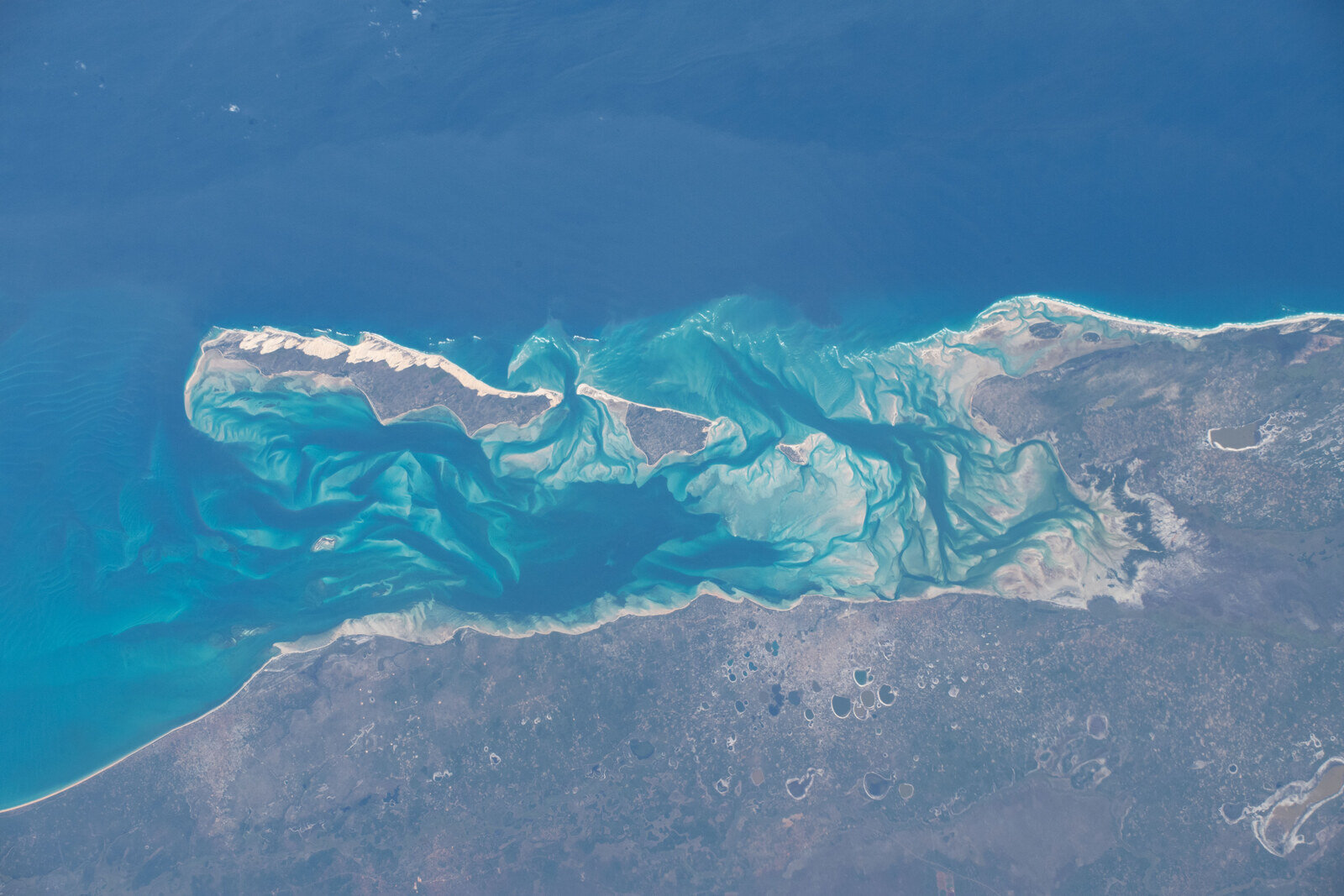
Almost all of those survivors live in one place. The Bazaruto Archipelago lies off the coast near Vilanculos in Mozambique, a chain of five islands (Bazaruto, Benguerra, Magaruque, Santa Carolina and Bangué) with shallow channels, tidal flats and wide seagrass meadows between them and the mainland. The Bazaruto Archipelago National Park was declared on 25 May 1971, which makes it Mozambique's oldest marine protected area, and it now covers about 1,430 square kilometres. Since 2017, the park has been co-managed by the conservation organisation African Parks together with Mozambique's national conservation agency, ANAC, under a long-term agreement.
Aerial surveys between 2017 and 2021 estimated about 325 dugongs in the Bazaruto seascape, a figure close to an earlier 2006 to 2007 estimate of around 359. That suggests the population has held roughly steady. The Bazaruto area is thought to hold more than 90 percent of all the mature dugongs left in East Africa, which is why it is described as the last viable dugong population on the East African coast. The proportion of calves seen in surveys has stayed above ten percent, a hopeful sign that the animals are still breeding well.
In 2024, a team from African Parks, the Mozambican government and James Cook University in Australia fitted the first satellite tags ever placed on dugongs in Africa. Eleven animals were tagged that first season, seven males and four females, with more added in 2025, bringing the total to 49 dugongs tagged over three seasons. The tracks have already shown something important: dugongs regularly leave the park. Some travelled more than 200 kilometres south to Inhambane Bay, and others moved north towards Govuro Bay. Around 92 square kilometres of seagrass north of the park, towards Inhassoro, has been mapped and is not yet protected.
On the water, more than 80 rangers run roughly 10,000 patrols a year across the park, removing illegal nets, enforcing fishing rules and working with the island communities who depend on the same sea. A new ranger outpost has been built at Nhamabue to cover more of the dugong range.
What Threatens Dugongs?
Gillnets. The biggest single threat. A dugong that swims into a gillnet cannot surface to breathe and drowns within minutes. Most deaths are accidental, and in a population this small, a few lost females a year matters enormously.
Seine and drag nets. Beach seines and drag nets pulled across shallow flats tear up seagrass, destroying the food the dugongs need, as well as catching animals directly.
Hunting. Dugongs have been hunted for meat and oil along the East African coast for centuries. Hunting is illegal in Mozambique, but an animal found tangled in a net is still sometimes killed and eaten.
Boat strikes. Because dugongs spend so much time just below the surface, fast boats in shallow channels are a real danger, especially to slow-moving mothers and calves.
Seagrass loss and climate change. Run-off, sediment, coastal building, cyclones and marine heatwaves can all damage seagrass meadows. Without the meadows, the dugongs have nowhere to feed.
Where to See Dugongs in Africa
Seeing a dugong is never guaranteed, and anyone who promises one is not being honest with you. But there are places where your chances are real:
Bazaruto Archipelago, Mozambique. The heart of the matter. Dugongs are most often seen in the channels and over the seagrass beds between Bazaruto, Benguerra and the mainland, usually from a boat on a calm day, and sometimes while snorkelling or diving with a marine guide. Lodges on the islands run ocean outings with guides who know the feeding areas and the rules for approaching marine wildlife. Our Bazaruto Archipelago guide covers the islands, the seasons and the lodges in full.
Marsa Alam, Egypt. Africa's Red Sea coast holds the continent's other well-known dugongs, and the sheltered bays south of Marsa Alam are one of the few places in the world where individual animals graze close enough to shore to be seen by snorkellers. The photographs and film in this article were taken there.
Elsewhere on the East African coast. Small, scattered numbers are still reported from Tanzania, Kenya and Madagascar, but sightings are rare and unpredictable.
If you do find yourself in the water with one, the rules are simple. Never chase, touch or block its path to the surface. Keep a respectful distance and let the animal decide how close it comes. Stay calm and quiet, keep fins off the seagrass, and skip the flash. Boat skippers should slow right down over seagrass beds. The best sighting is the one where the dugong carries on feeding as if you were not there.
For the wider picture of Mozambique's islands, see our Mozambique holiday packages, the &Beyond Benguerra Island review, our guide to the best diving in Africa, and our leatherback turtle facts, the giant that nests on the same Indian Ocean coastline.
The Sirenians of the World
There are only four living sea cows on earth, and one famous ghost. Two of them live in Africa:
Photo Credits
Hero, tail fluke, breathing near the surface, feeding trail, silt plume, golden trevally escort and all film footage (Marsa Alam, Red Sea): Kora27 (CC BY-SA 4.0). Feeding with golden trevally and diver photographing a dugong: Julie (CC BY-SA 3.0). Head and bubbles: Camille Ménard (CC BY-SA 3.0). Profile and underside: Alberto Scarani (CC BY-SA 3.0). Head close-up: Jean-Paul Boerekamps (CC0). Grazing in a sand cloud: Chris Chucholl (CC BY 4.0). Andaman Sea: Var (CC BY-SA 4.0). Snout on the seagrass: Kris Mikael Krister (CC BY 3.0). Grazing in the shallows: Jerome Paillet, IFREMER (CC BY 4.0). All photographs and film are from Wikimedia Commons.