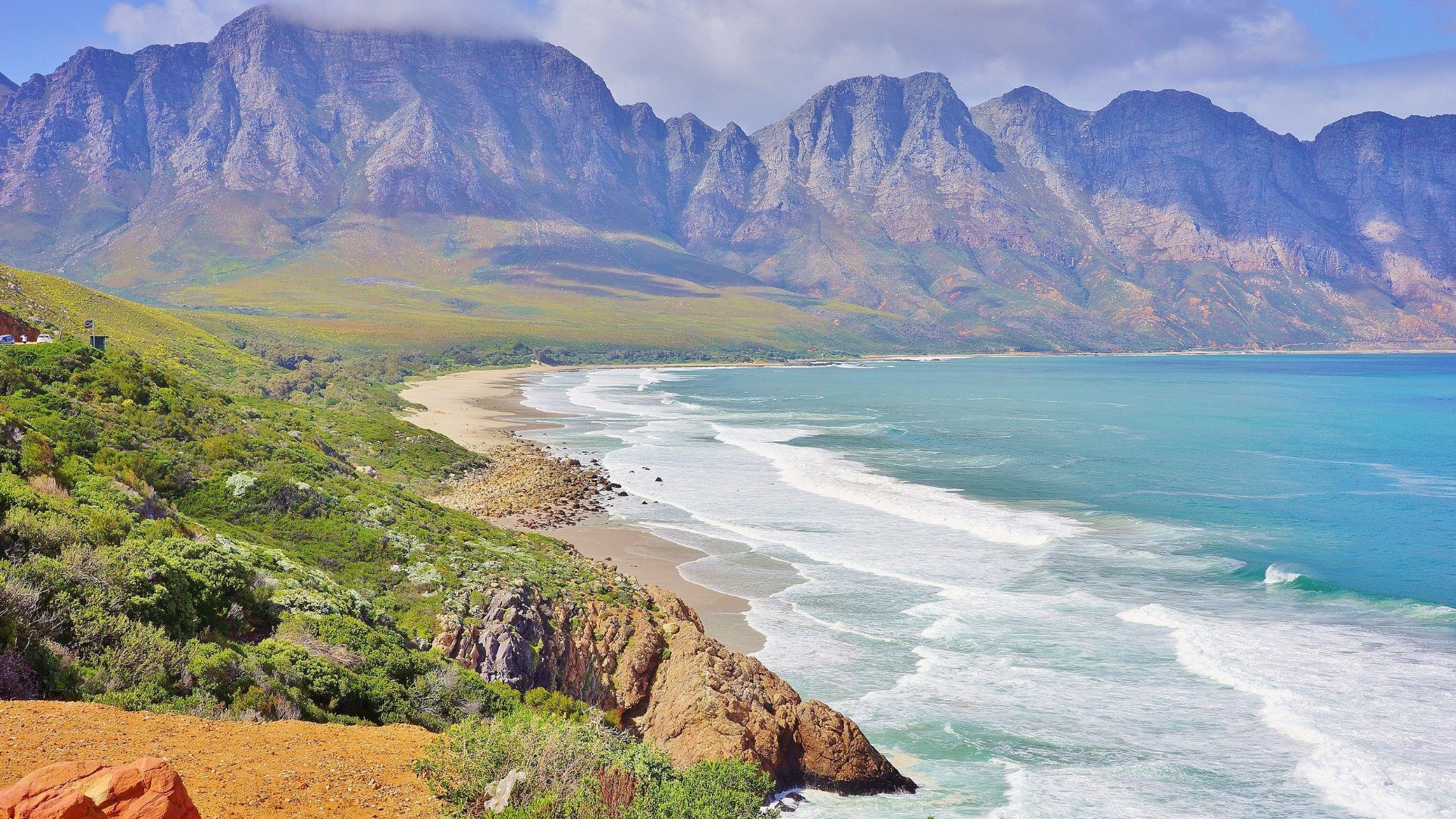
Ask almost anyone, anywhere in the world, where to see a great white shark, and the answer comes back the same: South Africa. For the better part of thirty years that was simply true, and it was true in one specific place — a narrow channel of cold green water off the fishing town of Gansbaai, two hours east of Cape Town, called Shark Alley. More great whites were seen, filmed, studied and dived with there than anywhere else on the planet. It was the setting for the breaching-shark footage that made the species famous, the base for the scientists who learned most of what we know, and the first stop on every ocean traveller’s list.
That story is still largely true. But it has changed in ways most guides have not caught up with, and being honest about the change is the whole point of this one. The great white sharks of South Africa have redrawn their own map over the last decade. A pair of specialist killer whales emptied one famous bay almost overnight. The most dependable great white water in the country is no longer where the magazines say it is. And the honest answer to where do great white sharks live in South Africa now depends on the year, the season, and which part of the coast you ask about.
This is the current picture, region by region, written by people who send travellers to these boats every week and hear back from the skippers. It covers the five coasts where great whites still move, which one gives you the best chance today, the true story of why the sharks left False Bay, what the animal is actually like when it rises under a boat, and how a shark encounter folds into a wider Cape and safari trip. If you want the pure day-trip logistics for one town — prices, departure times, what to wear — our focused Gansbaai shark cage diving guide handles that. This piece is about the sharks themselves, and where on this long coast you will find them.
Why South Africa holds the world’s great whites
Three things stack up along this coast to make it great white country. First, the water. Two great currents meet near the southern tip of Africa — the cold, nutrient-heavy Benguela sweeping up the west coast, and the warmer Agulhas running down the east. Where they mix, the sea is rich, cold and alive, exactly the conditions a cold-blooded apex predator built for ambush hunting likes to work in.
Second, and more to the point, the food. Scattered along the Cape coast are rocky islands packed with Cape fur seals — Dyer Island off Gansbaai, Seal Island in False Bay, Seal Island off Mossel Bay, the colonies of Algoa Bay. A single colony can hold sixty thousand seals. A fat young seal is the richest meal a great white can take, and the channels around these islands are the killing grounds where the sharks wait. Where the seals are, the sharks follow; when that balance breaks, as it did in False Bay, the sharks leave.
Third, access. The seal islands sit close to working harbours — Gansbaai, Kleinbaai, Mossel Bay, Simon’s Town — so a boat can reach the sharks in fifteen to forty minutes. That is why South Africa, almost alone in the world, lets ordinary travellers with no diving qualification stand in a cage a few feet from a wild great white before lunch and be back on dry land by early afternoon.
At a glance: the great white coasts compared
| Region | Base town | Reliability now | Best season | What makes it special |
|---|---|---|---|---|
| Gansbaai & Dyer Island | Kleinbaai / Gansbaai | Good, variable | Apr–Sep | Shark Alley; the original cage-diving coast |
| Mossel Bay | Mossel Bay | Most reliable | Year-round, best Jun–Oct | Seal Island whites that never left |
| Plettenberg Bay & Algoa Bay | Plett / Gqeberha | Quiet, improving | May–Sep | Uncrowded eastern seal colonies |
| False Bay & Seal Island | Simon’s Town | Very low since 2017 | Historically May–Sep | The breaching “flying sharks”; now mostly absent |
| Struisbaai & Quoin Point | Agulhas coast | Occasional | Winter | Africa’s southern tip; tagged transient whites |
1. Gansbaai & Dyer Island — the original great white capital
Gansbaai, and specifically its small working harbour at Kleinbaai next door, is where modern great white shark tourism was born. Offshore lies Dyer Island, a low scrub-covered island thick with African penguins and seabirds, and beside it a bare granite rock called Geyser Rock, home to roughly fifty to sixty thousand Cape fur seals. The channel between the two — Shark Alley — is only a few hundred metres wide, and for decades it was the single most reliable place on Earth to watch a great white shark.
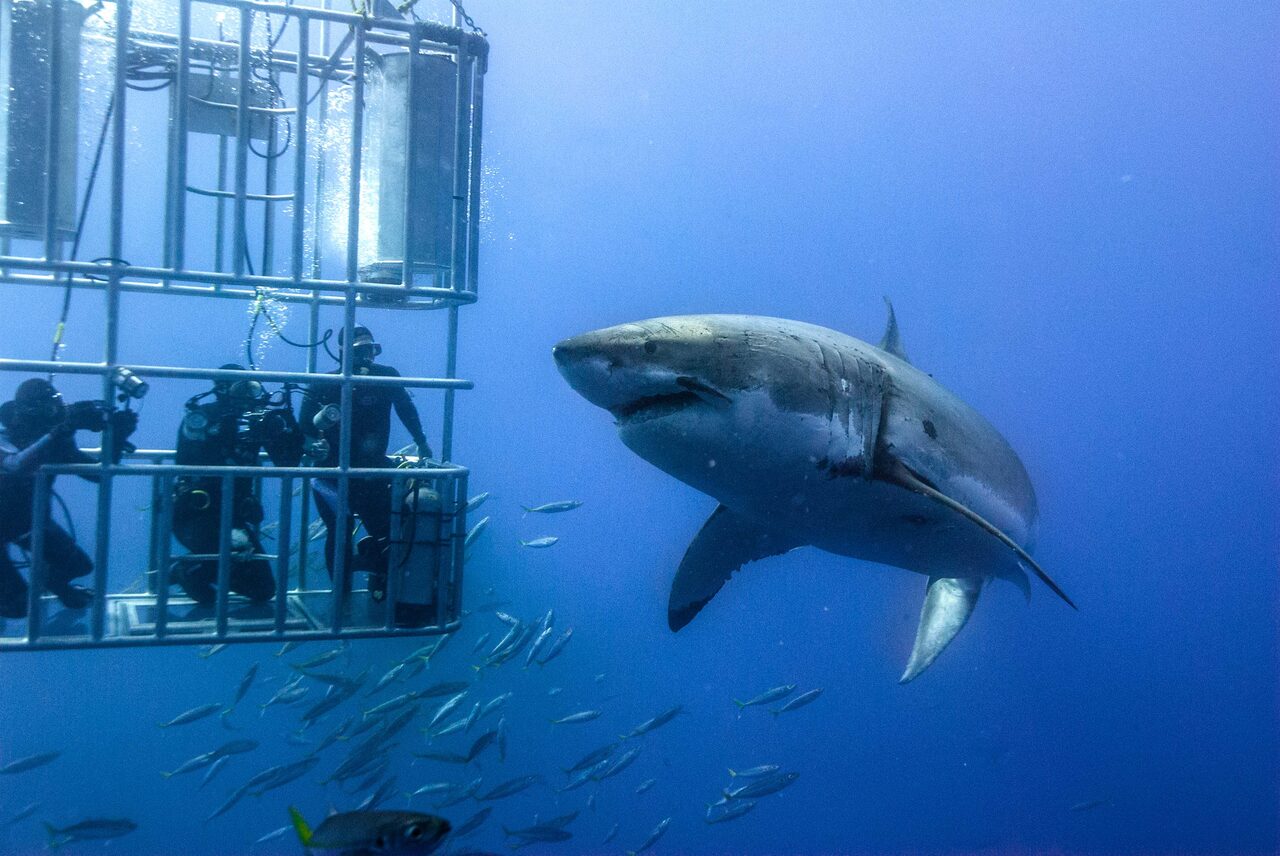
The sharks here hunt the seals that stream in and out of the colony, and the cage boats work the same water, drawing the animals close with a bait line and the smell of mashed sardine. On a good day you lower yourself into a steel cage fixed to the side of the boat, hold the bar, and duck under when the crew calls the shark — and a four-metre great white glides past the bars close enough to count the scars on its flank. You do not dive, you do not need a certificate, and you are never free in the water; the cage stays clipped to the hull at the surface.
Gansbaai’s sightings have become more variable since the orcas arrived on the coast (more on that below), and there are weeks when the whites thin out and the operators honestly tell you so. But it remains a working great white coast with the deepest expertise anywhere, seasoned boats and crews, and the bonus of Dyer Island’s penguins and whales around it. For the full day-trip detail — what it costs, how the morning runs, seasickness, what to bring — read the dedicated Gansbaai cage diving guide.


2. Mossel Bay — the most reliable great white water now
Here is the fact that most guides still get wrong. The single most dependable place to see a great white shark in South Africa today is not Gansbaai. It is Mossel Bay, the unassuming harbour town that marks the western start of the Garden Route, about four hours east of Cape Town.
Mossel Bay has its own Seal Island, a short run from the harbour, with a resident population of great whites that stayed put while the drama played out on the Cape coast. When the orcas pushed the sharks out of False Bay and rattled Gansbaai, Mossel Bay’s whites carried on much as before, and the town’s cage operator now records some of the highest sighting rates in the country — often close to every trip in the good months. The sharks here tend to be a little smaller on average than the giants of Shark Alley, but they are present, curious and seen all year, with winter and early spring (roughly June to October) the strongest window.
For a traveller the practical upside is large. If a great white is high on your list and you cannot afford a wasted day, Mossel Bay gives you the best odds on the coast, and it sits right on the Garden Route so the trip costs you no detour. You can dive with sharks in the morning and be watching whales or walking a forest trail by the afternoon. See how it links to the rest of the region in our Garden Route guide.
3. Plettenberg Bay & Algoa Bay — the quiet eastern option
Carry on east along the Garden Route and the great white story continues, more quietly. Plettenberg Bay has a resident seal colony on Robberg Peninsula and the islands offshore, and great whites patrol it through the cooler months; local operators run shark cage and viewing trips that rarely see a crowd. Further east again, around Gqeberha (Port Elizabeth), the islands of Algoa Bay — St Croix and Bird Island — hold large seal and seabird colonies and a scattering of great whites, in water that very few shark tourists ever reach.
This eastern coast will not give you Gansbaai’s thirty years of expertise or Mossel Bay’s sheer hit rate, but it offers something the famous bays cannot: space. If the idea of sharing a boat with twenty other people dulls the thrill for you, the eastern seal colonies are worth asking about, especially folded into a trip that already runs through Plett, Addo and the Eastern Cape’s malaria-free Big Five reserves. It is the natural shark add-on for travellers building an eastern Garden Route and Addo itinerary.
4. False Bay & Seal Island — the home of the flying sharks
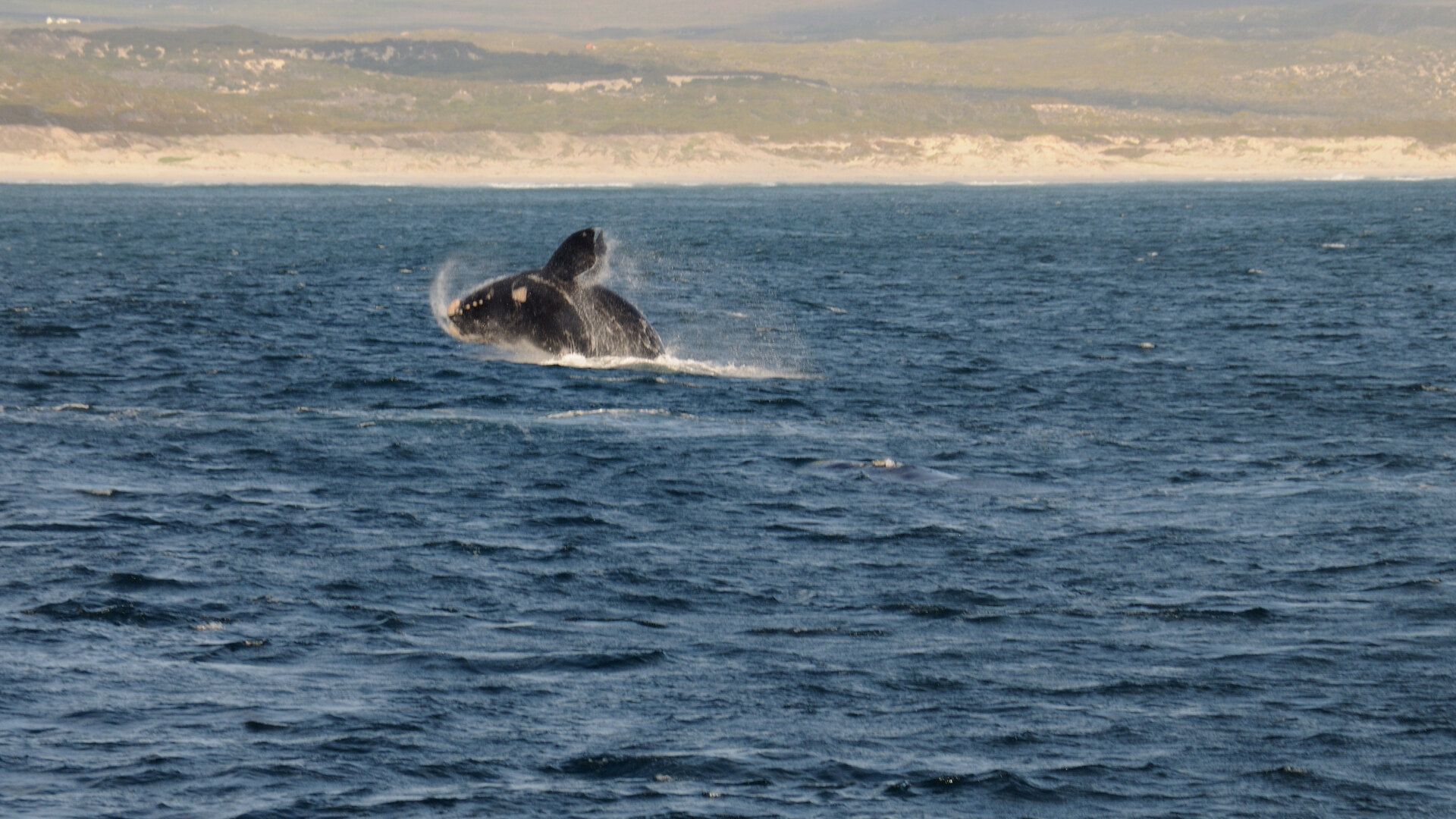
No account of South Africa’s great whites is honest without False Bay, and none is honest if it pretends the bay is what it was. For roughly two decades, the deep-water channel off Seal Island, in the middle of False Bay just beyond Simon’s Town, produced the most astonishing shark behaviour ever filmed anywhere. At first light in winter, great whites would rocket up from the dark beneath a lone seal and launch their entire bodies clear of the water — two tonnes of shark fully airborne, seal in its jaws. Researchers called it the predatory breach. The world called them the flying sharks, and the footage went around the planet.
Then it stopped. Beginning around 2015 and accelerating sharply after 2017, the great whites of False Bay dwindled, and by 2019 the bay’s famous breaching hunt had effectively ended. For the first time in living memory, a full year passed with no confirmed great white sightings at Seal Island. The cause, now well documented, is the subject of the next section — and it is the single most important thing to understand about great white sharks in South Africa today.
So should you go to False Bay for great whites? Honestly, no — not in 2026. We will not sell you a Seal Island great white trip that the ocean cannot deliver. False Bay remains a wonderful stretch of coast for whales, penguins, seals and bronze whaler sharks, and it is minutes from the city, but the great whites are gone for now. For them, you go east. That shift — painful for the Cape, and quietly good news for Mossel Bay — is the heart of the current great white map.


The two orcas that changed everything: Port and Starboard
Around 2015, a pair of male orcas appeared off the South African coast, unusual animals with collapsed, bent-over dorsal fins — one folding left, one folding right — which earned them the names Port and Starboard. They belong to a rare, poorly understood population of killer whales that specialises in hunting sharks for their livers, which are huge, oil-rich and packed with energy.
These two became the apex predators of the Cape. They learned to catch great whites, flip them into the motionless state called tonic immobility, and open them with surgical precision to remove the liver, often leaving the rest of the carcass to wash ashore. The evidence arrived on the beaches: great white sharks, some over four metres, dead on the sand with a neat wound and the liver gone. After even a single such event, the surviving great whites of a bay would vanish — fleeing the area entirely, sometimes for months.
This is why False Bay emptied, and why Gansbaai’s sightings turned erratic: the sharks are not being wiped out, they are being frightened off, reading the presence of these specialist orcas and leaving. It is one of the clearest cases ever recorded of a top predator being displaced by an even higher one. It also explains the shift east — the orcas have ranged the Cape coast, and the great white strongholds that remain steadiest, like Mossel Bay, are those the pair has pressured least. The great white is not the unchallenged king of this ocean after all, and the story of Port and Starboard is the truest, strangest thing happening in South African waters right now. Most operators would rather you did not know it. We think it makes the animal, and the coast, more fascinating, not less.
The animal itself — size, speed and what it is really like
The great white (Carcharodon carcharias) is the largest predatory fish alive. South African adults commonly run three to four metres; the largest confirmed females reach around five to six metres and well over a tonne, and the biggest are almost always female — females outgrow males substantially. They are warm-bodied for a fish, keeping their muscles above water temperature, which lets them accelerate in cold water in a way their prey cannot match.
Up close, the thing that surprises almost everyone is how unhurried they are. The great white of the horror films thrashes and snaps; the great white under a cage boat is slow, deliberate and watchful, cruising past the bars with one black eye rolled toward you, turning away, circling back. They investigate with their mouths because they have no hands, which is the honest reason behind most of the rare bites on humans — a test, not a hunt. People are not on the menu; seals are. Watching one move is less like meeting a monster and more like meeting something very old and very certain of itself.
Their hunting is extraordinary. A great white attacking a seal at Seal Island would come vertically from deep water at speed, timing the strike to the low light of dawn, and the force could carry both shark and seal clear of the surface. That ambush from below is what produced the famous breach — and it is also why the species likes deep, dark water next to a seal colony, the exact geography of Seal Island, Dyer Island and Mossel Bay.
| Great white fact | The reality in South African waters |
|---|---|
| Typical adult length | 3–4 m; large females 5–6 m |
| Weight | Up to roughly 1,100–2,000 kg for big females |
| Main prey | Cape fur seals; also fish and rays |
| Body temperature | Warmer than the sea — a partial warm-blooded fish |
| Main natural threat | Orcas (Port and Starboard) hunting them for their livers |
| Threat to the species | Protected in South Africa since 1991; still globally vulnerable |
What a cage day is actually like
Whichever coast you choose, the shape of the day is similar, and it is far gentler than most people expect. You check in early at the harbour — Kleinbaai for Gansbaai, the working harbour at Mossel Bay — for a light breakfast and a safety briefing. The boat runs out to the island in fifteen to forty minutes and anchors in the channel. The crew puts out a bait line and, in some operations, a seal-shaped decoy, and begins the wait.
When a shark arrives, you pull on a wetsuit and weight belt and climb into the cage, which is bolted to the side of the boat and floats at the surface; your head stays above water except when you choose to duck under. There are no scuba tanks and no certification — you simply hold your breath for the few seconds a shark passes. Those who would rather stay dry get a superb view from the deck, often better for photographs, as the sharks work the bait at the surface. A trip runs three to five hours in total, most of it the boat ride and the wait, with the sharks themselves the sharp, lasting centre of it.
Two honest notes. First, this is wild-animal watching, not a show: some trips see many sharks, a few see none, and a responsible operator will tell you the recent sighting record before you book. Second, the sea off the Cape is cold and often choppy; if you are prone to seasickness, take something the night before and the morning of, and choose a calm-forecast day. Mornings are almost always better than afternoons for both seas and sharks.
When to go, coast by coast
Great white viewing in South Africa is a cool-water affair. Broadly, the sharks are most active and the water clearest in the autumn-to-spring window, from about April to October, with the depths of winter (June to August) often the strongest for numbers — though it is also the roughest sea. The exact best window shifts with the coast.
| Region | Best months | Notes |
|---|---|---|
| Gansbaai & Dyer Island | April–September | Winter brings bigger sharks; sightings variable year to year |
| Mossel Bay | Year-round, best June–October | The most consistent coast; calmer than Gansbaai in parts |
| Plettenberg Bay & Algoa Bay | May–September | Quiet, cool-season viewing on the eastern coast |
| False Bay | — | Great whites largely absent since 2017; go for whales and penguins instead |
If your heart is set on a great white and you have one shot at it, our advice in 2026 is plain: base the shark day on Mossel Bay, keep it early in the trip so a weather day can be rescheduled, and treat Gansbaai as the richer-but-less-certain alternative if your route keeps you in the Overberg.
Sharks, seals and the rest of the marine cast
A great white trip is rarely only about the shark. The same cold, rich water that feeds the sharks feeds an entire coast of wildlife, and a morning at sea off Gansbaai or Mossel Bay routinely throws in Cape fur seals porpoising around the boat, African penguins on Dyer Island, Bryde’s and — in season — southern right and humpback whales, and the clouds of gulls, terns and cormorants that wheel over any feeding event. That cast is what gives South Africa its Marine Big Five — whale, shark, seal, dolphin and penguin — all catchable on the same stretch of coast.
It is why we so often build a great white morning into a broader ocean day rather than selling it alone. Pair it with whale watching in the Overberg or the Garden Route and you have two of the ocean’s greatest animals in a single outing, with the seabirds and seals thrown in for nothing.
How the great whites fit into a bigger South African trip
The beauty of a great white encounter here is that it sits in the middle of everything else South Africa does best. A shark morning at Gansbaai folds neatly into a Cape Town and safari trip — Table Mountain, the Cape Peninsula, the Winelands and a malaria-free Big Five reserve within a couple of hours’ drive. A shark dive at Mossel Bay or Plett is simply one stop along a Garden Route self-drive that also takes in forests, lagoons, Addo’s elephants and the Eastern Cape reserves.
Done that way, the great white stops being a single box-ticked outing and becomes one chapter of a trip that reaches from the ocean deep into the bush — the same hand that watched a shark circle a cage in the morning tracking a leopard from a game vehicle a few days later. Those are the journeys our team enjoys shaping most, and the ones that use this long, strange, generous coast to the full.
Protecting the great white
South Africa was the first country in the world to give the great white shark full legal protection, back in 1991, long before most of the world took the species seriously. The cage-diving industry that grew up afterwards has been, for all the debate around it, a genuine force for that protection: it put a living economic value on a shark that fishermen once killed on sight, it funded much of the research that mapped the population, and it turned tens of thousands of visitors into people who care whether the animal survives.
The great white is still classed as vulnerable worldwide, and the South African population is small — likely only a few hundred breeding adults — which is exactly why the orca pressure, the occasional net and the slow reproductive rate of the species all matter so much. Choosing a licensed, research-linked operator, keeping a respectful distance, and understanding the animal rather than fearing it are the small, real ways a traveller helps. The sharks have had a hard decade on this coast. Seeing them, honestly and well, is part of how they keep their value.
Where will you meet your great white?
The map has moved, but the animal is still here — cruising the green channel off Dyer Island, holding steady at Mossel Bay’s Seal Island, patrolling the quiet eastern colonies, and, one day perhaps, returning to the bay it made famous. Tell us which coast your route runs through and how much certainty you need, and we will point you at the right harbour, the right operator and the right week, then build the shark morning into a journey that carries you from this cold, wild ocean all the way to the bush. When you are ready, our team will map the whole thing around you.