Key Takeaways
- 🦈 Largest confirmed whale shark: 18.8 metres (61.7 ft), roughly 34 tonnes
- 🦈 Filter feeder on plankton, krill and fish eggs — throat only the width of a baseball
- 🦈 Deepest recorded dive: 1,978 metres (6,490 ft)
- 🦈 Spot pattern is unique to each animal — used as a visual fingerprint for photo-ID
- 🦈 Only pregnant female ever studied carried approximately 300 pups
- 🦈 Lifespan estimated at 70 to 130 years; sexual maturity around 30 years
- 🦈 Global population declined 50 to 79 percent over three generations (IUCN Endangered)
- 🦈 Moved to CITES Appendix I on 5 March 2026
- 🦈 Tofo, Mozambique: 87 percent decline in sightings between 2005 and 2019
What Is a Whale Shark?
A whale shark (Rhincodon typus) is a shark, not a whale. It breathes through gills, has a cartilaginous skeleton and belongs to the class Chondrichthyes, the same group as rays, skates and all other sharks. The "whale" in its name refers only to its size. It is the sole living member of the family Rhincodontidae and the order Orectolobiformes, which also includes wobbegongs and nurse sharks.
The species was first described in 1828 by the British military doctor Andrew Smith, based on a specimen harpooned in Table Bay, Cape Town, South Africa. The generic name Rhincodon comes from the Greek for "rasp-tooth," a reference to its tiny, file-like teeth arranged in more than three hundred rows, which play no part in feeding.
It is the largest non-mammalian vertebrate alive, and there is nothing else in the sea quite like it. The closest living relative is the zebra shark (Stegostoma tigrinum), a small, bottom-dwelling species that grows to about 2.5 metres.
How Big Is a Whale Shark?
Most adult whale sharks measure 10 to 12 metres and weigh somewhere in the region of 15 to 20 tonnes. The largest individual ever reliably measured was 18.8 metres (61.7 feet) long, with an estimated weight of about 34 metric tonnes. Claims of 20-metre-plus animals appear in older literature, but none has been confirmed with a tape measure.
The skin alone is up to 15 centimetres thick, the thickest of any living animal. It is armoured with tiny, tooth-like scales called dermal denticles and backed by a tough layer of collagen. The head is wide and flattened, the mouth terminal (at the front of the head, not underneath like most sharks), and the two eyes are small relative to the body — about the size of a golf ball on an animal the length of a lorry.
Females are thought to grow somewhat larger than males on average, though data are scarce because so few mature females have been measured.
The Spot Pattern: A Living Fingerprint
Every whale shark carries a unique pattern of pale spots and vertical stripes on its dark-grey back, concentrated in the area behind the gills and above the pectoral fins. No two patterns are alike, and they remain stable over time, making each animal individually identifiable from a single photograph.
Researchers worldwide use this feature through photo-identification platforms like Sharkbook.ai (formerly known as Wildbook for Whale Sharks). A diver or snorkeller photographs the flank behind the left gill slit, the image is uploaded, and an algorithm matches the pattern against a global database. As of 2024, the system held records for more than 12,000 individual whale sharks across dozens of aggregation sites.
Some individuals have been re-sighted years apart and thousands of kilometres from where they were first photographed, giving scientists hard evidence of movement corridors and site fidelity. At Ningaloo Reef in Western Australia, for example, some males have returned to the same stretch of coast for more than 30 consecutive years.
How Whale Sharks Feed
Despite having a mouth that can open to 1.5 metres wide, a whale shark's throat is only about the width of a baseball. Everything it eats is small: zooplankton, krill, copepods, fish eggs, crab larvae, small anchovies and sardines. It is an obligate filter feeder.
Whale sharks use two distinct feeding methods:
Ram feeding. The shark swims forward with its mouth wide open, forcing water across a set of spongy filter pads inside the gill arches. Food particles are trapped, water passes out through the gill slits. This is the mode you usually see in photographs — a head-on view of a wide-open mouth moving through a cloud of plankton.
Active suction feeding. The shark hangs vertically or nearly so, often with its head at the surface, and pumps water into its mouth with a rapid gulping action — sometimes described as "bobbing." Fishermen in Southeast Asia have watched whale sharks station themselves below the surface at night beneath lights that attract plankton, gulping in a steady rhythm. This is the method that allows them to concentrate on dense patches of food, particularly fish eggs released during mass spawning events.
The filter pads are made of a mesh of cartilaginous rods covered in a tissue that acts like a sieve, retaining particles down to about one millimetre. Whale sharks can process more than 6,000 litres of water per hour during active feeding. Despite this enormous volume, they are selective feeders that target the richest patches available, often timed to plankton blooms or coral spawning events.
Deep Dives: Nearly Two Thousand Metres Down
Whale sharks spend much of their visible life near the surface, but satellite tags have revealed a different story below. The deepest recorded dive by a whale shark reached 1,978 metres (6,490 feet), deep into the mesopelagic zone where no sunlight reaches and temperatures drop below 5°C.
These deep dives are not rare events. Tagged individuals regularly descend to 500 or 1,000 metres between surface-feeding bouts, often in a repeated pattern of rapid descent and slow ascent. Scientists have proposed several reasons: thermoregulation (cooling the body after hours of warm surface feeding), foraging on deep-scattering layers of zooplankton, and navigation using deep-water temperature or chemical gradients.
One study in the Atlantic tracked a whale shark that made oscillatory dives to 1,896 metres over several days during a long-distance crossing. The pattern suggested the animal was using the deep water between feeding stops in a way that minimised energy expenditure, gliding downward and swimming back up.
Lifespan and Growth
Whale sharks are among the longest-lived of all vertebrates. Estimates of maximum lifespan range from 70 to 130 years, based on carbon-14 analysis of growth bands in their vertebrae. A 2020 study confirmed that the bands are laid down annually, one per year, settling a debate that had run for decades.
Growth is slow. Males reach sexual maturity at about 8 to 9 metres in length, corresponding to an age of roughly 25 to 30 years. Females are thought to mature at a similar size or slightly larger, but data are extremely limited because mature females are so rarely encountered. Juveniles grow at roughly 20 to 30 centimetres per year; growth slows as they age.
The combination of late maturity, slow growth and long life makes the species acutely vulnerable to population decline. When a breeding female is killed, the gap she leaves in the population may not be filled for decades.
Reproduction: Three Hundred Pups
Almost everything known about whale shark reproduction comes from a single animal. In July 1995, a female whale shark was harpooned off the coast of eastern Taiwan. She was 10.6 metres long and contained approximately 300 embryos (later counts put the number between 304 and 307) across two uteri. The pups ranged from 42 to 64 centimetres in length and were at different stages of development, suggesting that the female had mated once and stored sperm, fertilising eggs in batches over time.
Whale sharks are ovoviviparous: eggs hatch inside the mother and the pups are born live. This is the largest litter ever recorded for any shark species. Despite that number, the reproductive rate is considered low because females likely reproduce only once every several years.
No one has ever observed a whale shark give birth in the wild. The birthing grounds are unknown. Some researchers believe pupping may occur in deep offshore water, possibly near oxygen minimum zones, which would explain why newborns are almost never seen. The smallest free-swimming whale shark ever reliably measured was about 55 centimetres long, found in the Philippines.
Where Whale Sharks Live
Whale sharks are found in all tropical and warm-temperate oceans, roughly between latitudes 30°N and 35°S. They are pelagic and highly migratory, capable of crossing entire ocean basins. Satellite-tagged individuals have covered more than 12,000 kilometres in a single tracked journey.
They tend to aggregate seasonally at sites where food concentrates: coral spawning events, upwelling zones, river mouths and coastal shelves. The best-known aggregation sites include Ningaloo Reef (Western Australia), the Yucatán Peninsula (Mexico), Donsol (Philippines), South Ari Atoll (Maldives), Mafia Island (Tanzania) and the coast of southern Mozambique.
The Indo-Pacific holds about 75 percent of the global population. The Atlantic population is smaller and less well studied, with sightings concentrated in the Gulf of Mexico, the Caribbean and around the Azores and Cape Verde.
What Threatens Whale Sharks?
Bycatch. The single biggest threat worldwide. Whale sharks are caught incidentally in purse seine nets targeting tuna, in gillnets and in other commercial fishing gear. Because they feed near the surface alongside tuna schools, purse seines are a particular danger. Mortality from bycatch is difficult to monitor and almost certainly under-reported.
Vessel strikes. A 2022 study in Current Biology found that 92 percent of whale shark habitat overlaps with global shipping lanes. The researchers estimated that lethal vessel strikes could rival fishing as a cause of death, based on satellite-tracked sharks that abruptly stopped transmitting in busy shipping corridors. Because whale sharks feed at or near the surface and are slow swimmers, they are especially vulnerable to large, fast-moving cargo ships.
Targeted fishing and trade. Whale sharks have been hunted commercially for their meat, fins, skin and liver oil, primarily in China, Taiwan, India and the Philippines. Most countries have now banned the trade, but illegal fishing continues. In March 2026, the species was moved to CITES Appendix I (upgraded from Appendix II, where it had sat since 2002), which prohibits all international commercial trade in whale shark products.
Tourism pressure. At popular aggregation sites, poorly managed tourism can alter whale shark behaviour. Boats approaching too closely, excessive numbers of snorkellers in the water and physical contact with the animals can cause sharks to change feeding patterns, dive away from food sources or abandon a site. Responsible operators follow strict approach codes.
Climate change. Rising ocean temperatures are shifting the distribution and timing of plankton blooms, which may force whale sharks to travel further or change aggregation timing. Coral bleaching can reduce the spawning events that produce the dense clouds of fish eggs whale sharks rely on at certain sites.
Conservation Status
The whale shark is listed as Endangered by the IUCN (category A2bd), based on an estimated global decline of 50 to 79 percent over three generations (approximately 120 years). The Indo-Pacific subpopulation is assessed as Endangered; the Atlantic subpopulation as Vulnerable.
Key protections:
- CITES Appendix I — effective 5 March 2026, banning all international commercial trade (upgraded from Appendix II, listed since 2002)
- CMS Appendix I — listed since 2017 under the Convention on Migratory Species
- National protection in more than 50 countries, including India, the Philippines, Australia, the Maldives, Mozambique and Mexico
- Several aggregation sites are UNESCO World Heritage Sites or fall within marine protected areas
Despite these protections, enforcement remains difficult across the whale shark's enormous range. The species crosses dozens of national boundaries and spends much of its life in international waters beyond any single country's jurisdiction.
Whale Sharks in Mozambique: Tofo and Beyond
The coast of southern Mozambique, particularly the stretch near the town of Tofo in Inhambane Province, was once one of the most reliable places on earth to see whale sharks. Juveniles gathered year-round, drawn by three separate upwelling mechanisms that push cold, nutrient-rich water toward the surface and concentrate plankton within reach.
The Marine Megafauna Foundation, which has run a long-term monitoring programme at Tofo since 2003, documented an 87 percent decline in whale shark sightings between 2005 and 2019. The reasons are not fully clear: local threats like gillnet bycatch and vessel strikes account for some losses, but the decline may also reflect wider population changes across the western Indian Ocean, shifts in oceanographic conditions or movements to areas where monitoring does not occur.
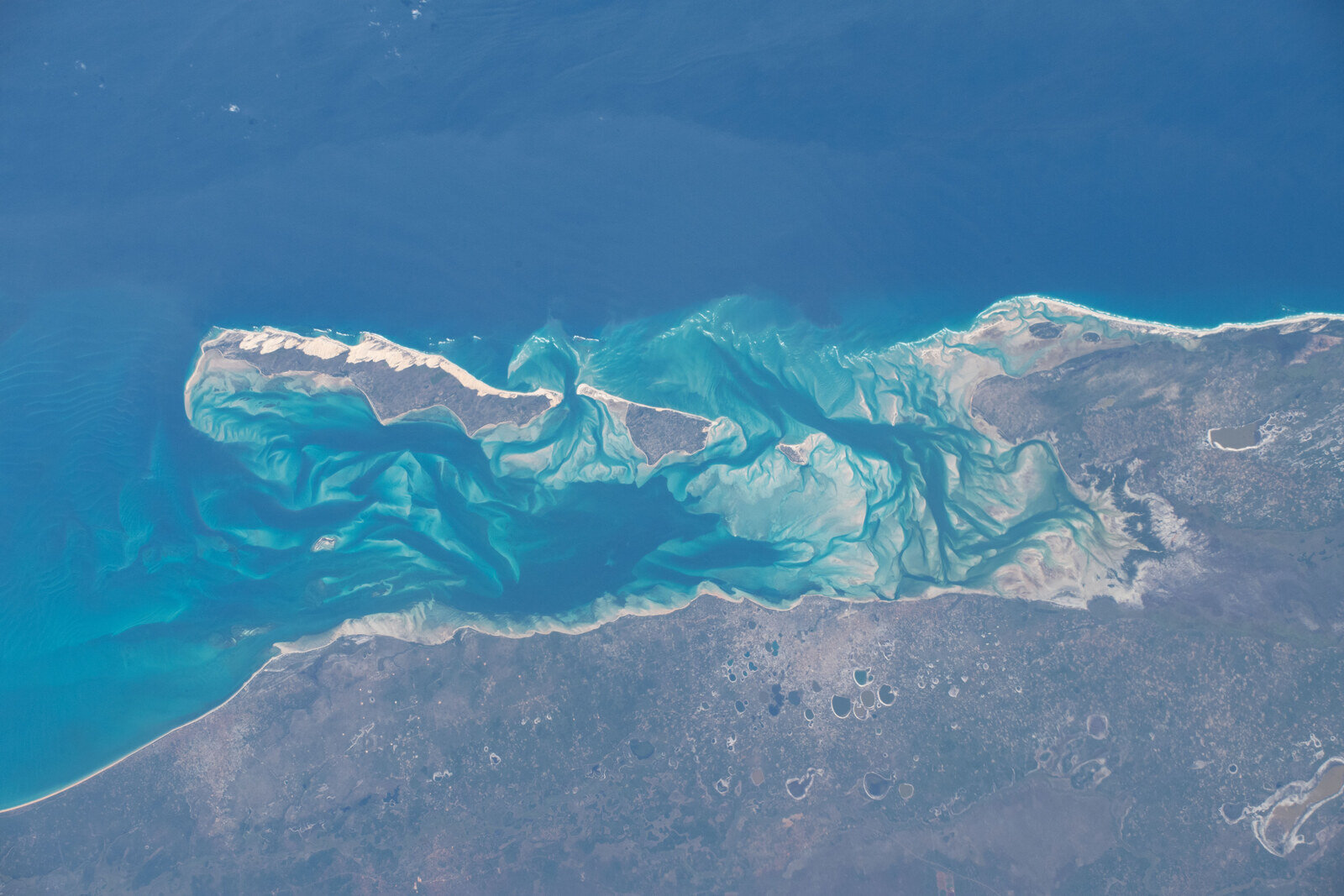
The Bazaruto Archipelago, further north along the Mozambique coast, has occasional whale shark sightings but is not a regular aggregation site. Bazaruto lacks the continuous upwelling that drives plankton density at Tofo. The archipelago is better known for its dugong population and reef systems. Rare sightings off the San Sebastian Peninsula were reported as recently as 2025.
Mozambique passed national legislation protecting whale sharks, and the species is included in the country's marine biodiversity plans. The Marine Megafauna Foundation continues to tag, photograph and track individuals using photo-ID through Sharkbook.ai, contributing data to the global picture.
Where to See Whale Sharks
Whale shark encounters are seasonal and weather-dependent, and no operator can guarantee a sighting. But the following sites offer the best chances:
Tofo, Mozambique. Year-round presence of juveniles, though numbers have dropped sharply since the mid-2000s. Ocean safaris depart from Tofo Beach daily in good conditions. The best months are October to March, when warmer water and plankton concentrations peak. See our Bazaruto Archipelago guide and Mozambique holiday packages for the wider coast.
Mafia Island, Tanzania. A less-visited site with year-round whale shark presence. Research published in 2023 described "cryptic residency" at Mafia: sharks are present throughout the year but spend time in deeper, offshore water when not visible at the surface. The core habitat covers about 13 square kilometres. Peak surface sightings run from October to February. The Mafia Island Marine Park regulates boat numbers and snorkelling conduct.
South Ari Atoll, Maldives. One of the most reliable year-round whale shark sites in the world, with a resident population of mostly juvenile males. The South Ari Atoll Marine Protected Area was designated specifically for whale shark conservation. Sightings are possible in every month of the year, with a slight peak from August to November.
Ningaloo Reef, Western Australia. A seasonal aggregation, March to July, timed to the mass spawning of coral on the reef. This is one of the best-studied whale shark populations, with photo-ID records stretching back more than 30 years. Numbers can exceed 300 individuals in a good season.
Donsol, Philippines. A seasonal aggregation, November to June, with peak numbers in February to April. The town of Donsol has built a community-based whale shark tourism programme that has become a model for responsible management.
For the wider marine picture, see our guide to the best diving in Africa, our leatherback turtle facts and our dugong facts from the Bazaruto Archipelago.
How to Behave Around a Whale Shark
Codes of conduct vary by country, but the core rules are consistent everywhere:
Stay at least three metres from the body and four metres from the tail. Never touch, ride or grab a fin. Do not use flash photography. Enter the water quietly, without jumping or splashing, and swim alongside the animal rather than directly at it or in front of its path.
Boats should approach at slow speed, cut the engine when within 50 metres and never position themselves directly over a feeding shark. Propeller injuries are a leading cause of scarring and injury at busy aggregation sites.
The best whale shark encounter is one where the animal carries on feeding as if you were not there. If a shark changes direction, dives or accelerates, it is telling you to back off.
Photo Credits
Whale shark at Oslob: GoPro HERO5 (CC BY-SA 4.0). Whale shark near a boat: Canon PowerShot (CC BY-SA 3.0). Red Sea snorkellers: Canon SD1200 IS (CC BY-SA 3.0). Open-mouth feeding: SONY DSC-H7 (CC BY-SA 2.0). Diver and whale shark: Canon PowerShot S110 (CC BY-SA 2.0). Whale shark at Mafia Island: Olympus TG-4 (CC BY-SA 4.0). Aquarium whale shark: Nikon D5600 (CC BY-SA 4.0). Indonesia whale shark: Adobe Lightroom (CC BY-SA 4.0). All photographs from Wikimedia Commons.