⚔️ Key Takeaways — Isandlwana & Rorke's Drift
- January 22, 1879: Two battles fought 15 km apart on the same day. Isandlwana = British defeat; Rorke's Drift = British heroic defence.
- Isandlwana Battlefield: 20,000 Zulu warriors annihilated a British camp of 1,800 men. White cairns mark where soldiers fell. The hill still dominates the landscape.
- Rorke's Drift: 150 British soldiers defended a mission station against 4,000 Zulus for 12 hours. 11 Victoria Crosses awarded — the most ever for a single engagement.
- Guided Tours Essential: Battlefield guides bring the history to life, explaining tactics, Zulu strategy and the human stories behind the memorials.
- Combine with Safari: The battlefields are 3 hours from Durban and 2 hours from Hluhluwe — perfect for adding cultural depth to a Big Five safari.
The Anglo-Zulu War: Context & Background
In 1879, the British Empire sought to expand its control over southern Africa, bringing it into conflict with the Zulu Kingdom — a highly organised military power under King Cetshwayo. The Zulus had one of the most formidable armies in Africa: disciplined regiments (impis), the deadly short stabbing spear (iklwa), and the "horns of the buffalo" encirclement tactic that had won countless battles.
British High Commissioner Sir Bartle Frere issued an ultimatum to Cetshwayo that was designed to be impossible to accept. When the deadline passed, British forces invaded Zululand on January 11, 1879. The stage was set for one of the most dramatic military confrontations in colonial history — and two battles that would shock the world.
Isandlwana: The British Army's Darkest Day
On the morning of January 22, 1879, a British camp of 1,800 men sat beneath the distinctive sphinx-shaped hill of Isandlwana. Lord Chelmsford, commanding the invasion force, had split his column, leaving Lieutenant Colonel Pulleine in charge of the camp with a mixed force of British regulars, colonial troops and African auxiliaries. What they didn't know was that 20,000 Zulu warriors were hidden in a valley just 8 kilometres away, waiting to strike.
Around midday, a British patrol stumbled upon the hidden Zulu impi. The element of surprise lost, the Zulu commanders ordered an immediate attack. The warriors poured over the hills in their classic "horns of the buffalo" formation — the chest charging the camp head-on, while the left and right horns swept around to encircle the British position.
The British fought desperately, but tactical errors — ammunition supply failures, dispersed formations, underestimating the Zulu threat — sealed their fate. By late afternoon, the camp was overrun. Over 1,300 British and colonial troops were killed, along with hundreds of African auxiliaries. Only a handful escaped. It was the worst defeat inflicted on a modern European army by an indigenous force armed primarily with spears and shields.
Walking the Isandlwana Battlefield Today
Visiting Isandlwana is a profoundly moving experience. The battlefield has been left largely untouched — the sphinx-shaped hill still looms over the grasslands, and white stone cairns mark the spots where British soldiers fell. There are over 1,200 cairns, each one representing a life lost in the space of a few hours.
A guided tour is essential. Local Zulu guides — many of them descendants of warriors who fought in the battle — walk you through the events of January 22, explaining how the Zulu impi moved, where the British lines collapsed, and why ammunition never reached the firing line. You'll stand on the nek (saddle) where the last British soldiers made their stand, and look out over the vast landscape where 20,000 Zulu warriors advanced.
The small museum displays artefacts recovered from the battlefield: musket balls, uniform buttons, Zulu spears and shields. There's also a memorial to the Zulus who fell — a reminder that this was a tragedy on both sides.
Rorke's Drift: The Defence That Saved an Empire's Honour
While the disaster at Isandlwana unfolded, 15 kilometres to the west, a small mission station called Rorke's Drift was being hastily fortified. Around 4:30 PM on January 22, survivors from Isandlwana arrived with news of the massacre. Lieutenant John Chard (Royal Engineers) and Lieutenant Gonville Bromhead (24th Regiment) realised they had minutes to prepare.
Just before 4:30 PM, 4,000 Zulu warriors — part of the reserve impi that had missed the Isandlwana battle — arrived at Rorke's Drift. What followed was one of the most heroic defences in military history. For 12 hours, 150 British soldiers held off wave after wave of Zulu attacks, fighting room-to-room as the Zulus breached the makeshift barricades of mealie bags and biscuit boxes.
By dawn on January 23, the Zulus withdrew, leaving 350 of their warriors dead. The British had lost 17 men. In recognition of the bravery shown, 11 Victoria Crosses were awarded — the most ever for a single engagement. Rorke's Drift became a legend, immortalised in the 1964 film "Zulu" starring Michael Caine.
Visiting Rorke's Drift Mission Station
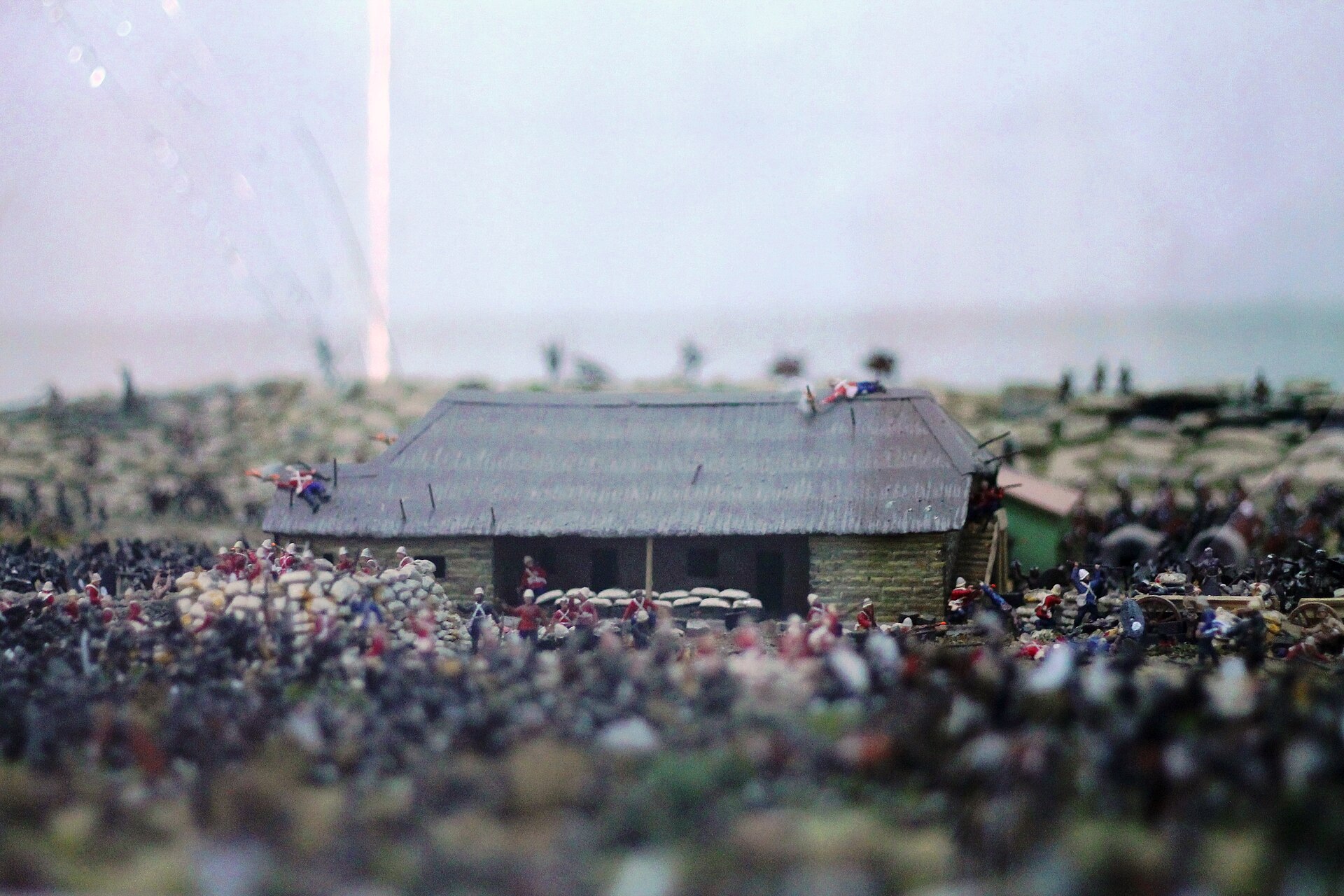
Today, Rorke's Drift is a modest mission station with a small museum and a reconstructed perimeter wall showing the layout of the 1879 defence. The museum displays weapons, uniforms, and vivid dioramas of the battle. Outside, plaques mark where key events occurred — the hospital building where Private Henry Hook earned his Victoria Cross, the stone kraal where the final stand was made, and the cemetery where the British dead are buried.
Guides recount the night of January 22–23 in gripping detail: how Private Hook defended patients in the hospital, how Corporal Allen and Private Hitch manned the barricade despite being wounded, and how the Zulus set fire to the thatched roof, forcing the British to abandon room after room. Standing in the museum courtyard, looking at the hills from which the Zulus attacked, you can almost hear the volleys of rifle fire and the war cries echoing across the valley.
| Battlefield | Date | Outcome | Highlights |
|---|---|---|---|
| Isandlwana | 22 Jan 1879 | Zulu victory | 1,200+ white cairns, sphinx-shaped hill, Zulu guide tours |
| Rorke's Drift | 22–23 Jan 1879 | British defence | 11 Victoria Crosses, mission station, reconstructed perimeter |
Practical Tips for Your Battlefield Tour
Most visitors explore both Isandlwana and Rorke's Drift in a full-day tour (7–8 hours including travel time from Durban or Ladysmith). The two sites are just 15 kilometres apart and are best visited with a professional guide who can explain the military tactics, political context and human stories.
Wear comfortable walking shoes and bring sun protection — both battlefields involve walking across open grassland. Photography is encouraged, and the landscapes are stunning. The best time to visit is autumn and winter (April to September) when the weather is mild and the grasslands are golden. Avoid peak summer (December to January) when it's hot and thunderstorms are common.
After your battlefield tour, consider visiting nearby sites: Blood River (the 1838 Voortrekker-Zulu battle), Fugitives' Drift (where two Victoria Cross recipients died fleeing Isandlwana), and the Talana Museum in Dundee (covering the later Anglo-Boer War).