Key Takeaways
- 🦍 Kahuzi-Biega is the only place on Earth set up to trek the Grauer's (eastern lowland) gorilla
- 🦍 The Grauer's gorilla is the largest of all four gorilla types and lives only in eastern DRC
- 🦍 It is critically endangered: numbers fell by about 80 percent in two decades, to fewer than 4,000
- 🦍 Two habituated families take visitors: Bonane (since 2013) and Mpungwe (since 2021)
- 🦍 A UNESCO World Heritage Site since 1980, on the In Danger list since 1997
- 🦍 Run by Congo's park authority ICCN with the Wildlife Conservation Society
- ⚠️ 2025-26: not safe to visit. The gateway city of Bukavu has been under armed control since early 2025; reputable operators have suspended bookings
- ✅ You can trek gorillas safely now in Uganda (Bwindi), Rwanda (Volcanoes) and the Republic of the Congo (Odzala)
Where Kahuzi-Biega Is, and Why It Matters
Kahuzi-Biega National Park sits in South Kivu province, in the far east of the Democratic Republic of the Congo, close to the border with Rwanda. The park covers around 6,000 square kilometres, running from the high, cool mountain forest near Bukavu down through a corridor to the hot lowland rainforest of the Congo Basin. It takes its name from two dormant volcanoes that stand over it: Mount Kahuzi, at 3,308 metres, and Mount Biega, at 2,790 metres.
The park was created in 1970, largely through the work of the Belgian conservationist Adrien Deschryver, who set it up specifically to protect the Grauer's gorilla. In 1980 it became a UNESCO World Heritage Site. Since 1997, after years of war spilled across the region, it has been on the List of World Heritage in Danger, where it remains today.
Day to day, the park is run by the Institut Congolais pour la Conservation de la Nature (ICCN), Congo's national park authority, working alongside the Wildlife Conservation Society (WCS). The gateway for visitors is the lakeside city of Bukavu, on the southern tip of Lake Kivu. From there it is roughly an hour and a half by road up to the Tshivanga Visitor Centre, the park headquarters at the edge of the mountain sector, where every gorilla trek has always begun.
The Grauer's Gorilla: The Largest Gorilla Alive
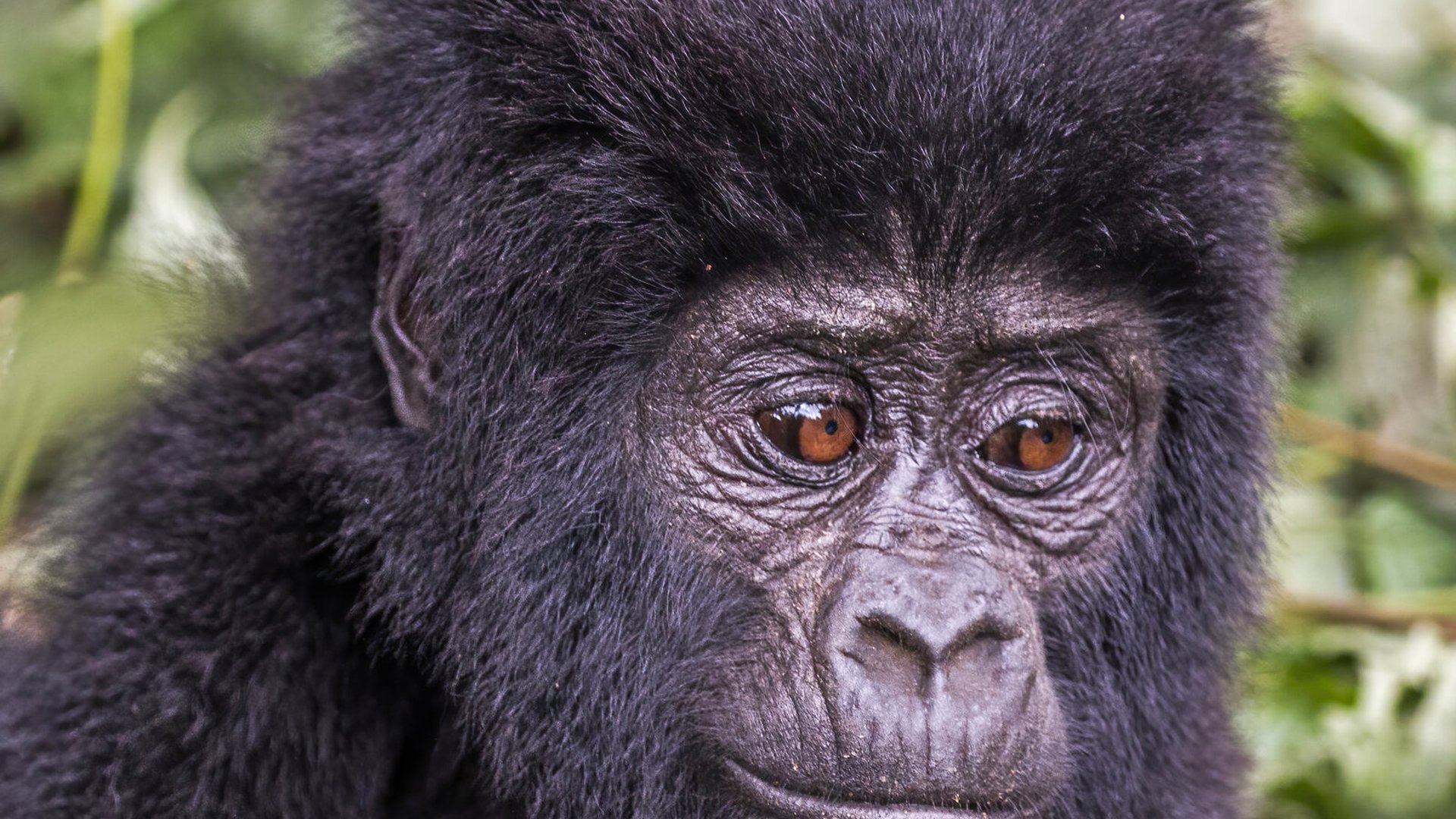
There are two species of gorilla and four recognised types. The western gorilla splits into the western lowland gorilla and the Cross River gorilla. The eastern gorilla splits into the mountain gorilla, which you trek in Uganda and Rwanda, and the Grauer's gorilla, also called the eastern lowland gorilla. The Grauer's is the one that lives only in eastern DRC, and it is the biggest of them all.
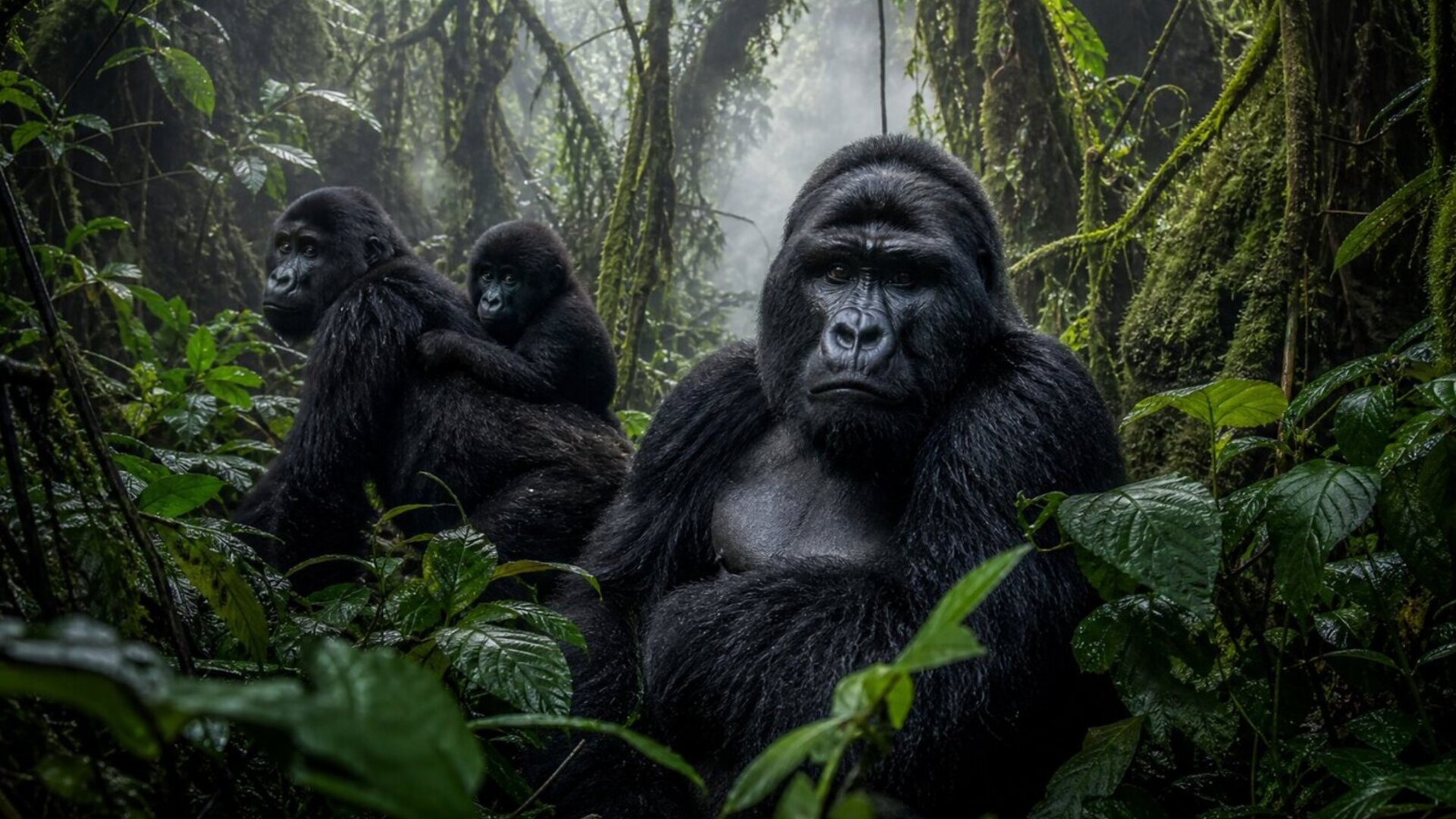
A mature Grauer's silverback can stand over 1.8 metres tall on two legs and weigh up to 210 kilograms, heavier than a mountain gorilla and far heavier than the western lowland gorilla. The body is thickset and jet black, the arms enormous, the face long. Older males carry the broad silver saddle across the back and hips that gives silverbacks their name. The hands are huge; a single palm is wider than a dinner plate.
The animal is named after Rudolf Grauer, an Austrian zoologist who collected the first specimens in the early 1900s. It feeds mainly on fruit, leaves, stems and bamboo shoots, and in the lowland forest it eats more fruit than its mountain cousins do. Family groups are led by a dominant silverback and can number anywhere from a handful of animals to more than thirty.
Critically Endangered: What Happened to the Grauer's Gorilla
The Grauer's gorilla is in serious trouble. In the mid-1990s researchers estimated around 17,000 animals across eastern DRC. A detailed survey led by WCS and partners, published in 2016, put the figure at fewer than 3,800, a fall of roughly 80 percent in about twenty years. On the strength of that work the IUCN moved the Grauer's gorilla to Critically Endangered, one step from extinct in the wild.
The collapse was driven by war and its knock-on effects rather than by habitat loss alone. Two decades of conflict in eastern Congo pushed armed groups and displaced people deep into the forest. Artisanal mining camps, many digging for the tin, tantalum and tungsten ores used in electronics, set up inside gorilla range, and the men in those camps ate bushmeat, including gorilla. Gorillas breed slowly, a single infant every four years or so, so a population cannot absorb that kind of hunting and recover quickly.
The picture is not hopeless. In the high mountain sector around Tshivanga, which has been protected and patrolled for longer, the gorilla families have held on and in places grown. That sector is where the habituated families live, and it is the part of the park that tourism was built to support.
Bonane and Mpungwe: The Habituated Families
Habituation is the slow, careful work of getting a wild gorilla family used to the presence of people, so that researchers can study them and visitors can stand quietly nearby without the animals fleeing or charging. It takes years, and it is never fully reversible. Kahuzi-Biega has long run habituated families for exactly this purpose.
The best known is the Bonane family, opened to visitors in 2013 and named after its silverback. Bonane's group has been the mainstay of gorilla tourism in the park, usually found within a reasonable walk of the Tshivanga headquarters. A second family, Mpungwe, was habituated and opened more recently, around 2021, giving the park a second group to spread visitor pressure and protect the animals from being over-visited.
Because these are lowland gorillas in gentler terrain than the steep volcanoes of Rwanda, treks here were historically shorter and less punishing on the legs, though the heat, humidity and mud of the Congo forest make their own demands. A typical visit put travellers within eight to ten metres of a family for a strict single hour.


What a Trek Here Involves (When the Park Reopens)
We are describing this in the past and conditional tense on purpose. The following is how gorilla trekking in Kahuzi-Biega has run in normal times, and how we expect it to run again once the region is safe. It is not a booking you can make today. Read the safety section below before you plan anything.
A trek started early. Visitors reported to the Tshivanga Visitor Centre at around 8am for a briefing from the park rangers: the rules, the family you would visit, the health precautions. Groups were kept small, usually a maximum of six people per family per day, to limit stress on the animals and the risk of passing on disease.
From the centre, trackers who had gone ahead at dawn radioed back the family's position. The walk to reach them ranged from under an hour to two or three hours, depending on where the gorillas had moved overnight. The forest is humid and often muddy, with dense undergrowth, so sturdy boots, long sleeves, gloves and a basic level of fitness mattered. Hiring a porter both eased the walk and put money directly into local pockets.
Once the family was found, the rules were strict and non-negotiable: a maximum of one hour with the gorillas, a distance of at least seven to ten metres, face masks mandatory to protect the animals from human respiratory infection, no flash photography, no eating or drinking near them, and a minimum age of 15. Anyone showing signs of a cold or flu was turned back. These rules exist because gorillas share so much of our biology that a human cough can kill them.
Permit prices, in normal times, were far lower than Rwanda's: historically around 400 US dollars for a non-resident, with reduced rates for East African residents and Congolese nationals, and a gorilla habituation experience offered at a higher price. We quote these only for context. Prices, availability and the park's rules will all be set afresh when it reopens, and nothing here should be read as a current rate.
An Honest Word on Access and Safety in 2025-26
Here is the part a responsible safari company has to say out loud. At the time of writing, we cannot and will not send a traveller to Kahuzi-Biega.
The conflict in eastern DRC escalated sharply in early 2025. In February 2025, armed forces of the M23 movement and the allied AFC coalition took control of Bukavu, the city that is the gateway to the park, following the fall of Goma further north. South Kivu province remains contested and unstable. The United States, United Kingdom and Canada all have their highest-level travel advisories in place for this part of the country, the "Do Not Travel" or equivalent level, citing armed conflict, kidnapping and the collapse of normal services.
Flights into the regional airport near Bukavu have been disrupted, border crossings with Rwanda have been subject to sudden closure, and the reputable gorilla operators who used to run Kahuzi-Biega have suspended their bookings. Insurance for travel into an active conflict zone is, for practical purposes, unavailable. No single gorilla sighting is worth a traveller's safety, and no responsible guide would pretend otherwise.
The rangers of ICCN, meanwhile, continue their work under conditions most of us cannot imagine. Protecting a forest and its gorillas through a war is among the most dangerous conservation jobs on Earth, and the people doing it deserve our respect and our support far more than they need our tourism right now.
Where You Can Trek Gorillas Safely Right Now
The good news is that the gorilla experience itself, standing quietly a few metres from a wild silverback and his family, is available right now in places that are stable, well run and genuinely safe. If that is what you want, here is where we send travellers today.
Uganda: Bwindi Impenetrable Forest. Bwindi holds roughly half the world's remaining mountain gorillas, with more habituated families open to visitors than anywhere else, and a long, settled record of safe, high-quality trekking. Permit prices sit well below Rwanda's. This is our first recommendation for most travellers. Read our Bwindi gorilla trekking guide, and for the slower, deeper option, our gorilla habituation experience guide, which puts you with a family for four hours rather than one.
Rwanda: Volcanoes National Park. The most polished and accessible mountain-gorilla experience, a short drive from Kigali's international airport, with excellent lodges on the park edge. Permits are the most expensive in Africa, but the ease and quality are hard to match.
Republic of the Congo: Odzala-Kokoua. A different animal and a different country, not to be confused with the DRC. Odzala, in the stable Republic of the Congo (Congo-Brazzaville), is the place to trek the western lowland gorilla in pristine Congo Basin rainforest, with habituated families and some of the finest forest camps in Africa. See our western lowland gorilla trekking guide for the full picture.
Not sure which suits you? Our comparisons of Congo vs Uganda vs Rwanda vs DRC and Congo vs Rwanda lay out the cost, difficulty and experience side by side, and our overview of where to see gorillas in Africa covers every option on the continent. The two journeys below are where most of our gorilla travellers start.


The Fight to Keep the Grauer's Gorilla Alive
Conservation in Kahuzi-Biega is not a quiet affair of research stations and quiet patrols. It is carried out in one of the hardest places in the world to do it. ICCN rangers patrol a forest that armed groups move through, and dozens of them have been killed in the line of duty over the years. WCS has worked in the region for decades, running the gorilla surveys that revealed the scale of the decline and the community programmes that try to give local people a reason to keep the forest standing rather than mine or hunt inside it.
Some of that work has shown results. Community-based monitoring, in which trained local teams track gorilla families and record signs of poaching, has helped stabilise groups in the protected mountain sector. Alternative-livelihood schemes, from fuel-efficient stoves to farming support, aim to reduce the pressure on the forest. And the two habituated families, Bonane and Mpungwe, are themselves a conservation tool: in peacetime, the money from gorilla permits helps fund the patrols that keep every gorilla in the park alive.
The honest truth is that the single biggest thing that would help the Grauer's gorilla is peace. Every lasting conservation gain in eastern Congo has depended on it, and every reversal has followed the return of conflict. That is why this guide ends where it does.
Best Time to Visit, for the Day It Reopens
For the day Kahuzi-Biega is safe again, the trekking seasons are the two dry spells: the long dry season from June to September, and the shorter dry window from January to February. In the dry months the forest trails are firmer, the going underfoot easier, and the gorillas often feed at accessible elevations.
The park has always offered more than gorillas. In normal times visitors could track eastern chimpanzees, climb the lower slopes of the two volcanoes, and look for the other forest wildlife of the Albertine Rift, one of the richest zones for birds and primates on the continent. All of that waits for peace, and so do we.
The Prize We Are Watching
We will say this plainly, because our founder, who was born in this region of Africa, believes it: the war in eastern Congo will end one day. It has ended before, and the forest and its gorillas have come back before. When that day comes, Kahuzi-Biega will once again be the only place on Earth to stand in front of a Grauer's silverback, the largest gorilla alive, in the forest that was set aside to save him.
Until then, we do two things. We keep this guide honest, so that no traveller walks into danger chasing a photograph. And we keep the door open, so that the moment the region is genuinely safe and the reputable operators return, we can take you. If the Grauer's gorilla is the animal you most want to meet, tell us. We will watch the ground for you, we will trek you to the gorillas you can safely reach in the meantime, and we will be ready for the day the forest of Kahuzi-Biega opens again.
Write to our team at res@privatetourscapetown.com or through our contact page, and we will plan a gorilla journey around what is safe, what is open, and what you most want to see.
Photo Credits
Grauer's and eastern lowland gorillas, Mount Kahuzi, Congo Basin rainforest, forest ridges and Lake Kivu: photographs from Wikimedia Commons, CC-licensed. Silverback in rainforest by Giles Laurent (CC BY-SA 4.0). Hero video assembled from free-licence Congo Basin forest footage.