Here is the honest truth about booking a safari from overseas. The international flight is rarely the problem. You can find a seat to Johannesburg or Nairobi on any airline site in ten minutes. The trouble starts after that: the regional connection to Maun or Kilimanjaro, the light aircraft that only flies in daylight, the 15-kilogram bag limit nobody mentioned, and the moment your long-haul lands two hours late and the next leg is on a separate ticket that nobody is watching.
That gap is exactly what African safari packages with airfare are meant to close. Instead of booking the land portion with one company and stitching your own flights around it, the whole chain goes on one booking: international flight, regional flight, bush plane, road transfer, camp. One team holds every ticket and every timing. If something moves, they move the rest.
We have been building these routings since 2008, and this guide is the version we would give a friend. It covers how the airfare is bundled, which gateway cities connect best, six sample routings with indicative from-prices, the luggage rules on light aircraft, when to book, and what is and is not included. If you are still choosing between countries, start with our guide to the best African safari tours and packages and come back here once you know where you are heading.
Key Takeaways
- A safari package with airfare covers three layers of flying: the long-haul into Africa, a regional flight to a safari hub, and often a light aircraft to the camp airstrip.
- The main entry points are Johannesburg (JNB), Cape Town (CPT), Nairobi (NBO) and Kilimanjaro (JRO), with Kigali, Victoria Falls, Maun and Windhoek as second-step hubs.
- Light aircraft usually allow 15 kg in East Africa and 20 kg in Botswana and southern Africa, hand luggage included, in a soft bag with no wheels or frame.
- Book 9 to 12 months ahead for July to October and the December holidays; 6 to 9 months is fine for the shoulder months.
- The real value of one booker is the misconnect: when a long-haul runs late, the regional and bush legs are rebooked for you, not left to you.
- All prices in this guide are indicative, per person sharing, economy class, and move with season, cabin and departure city.
How the airfare is actually bundled
When people hear "flights included" they picture one plane. On a safari it is almost never one plane. A typical routing has three layers, and a good package handles all of them.
Layer one: the long-haul
This is your flight from home into Africa. From North America it is usually 15 to 18 hours of flying; from Europe it is an overnight of 9 to 11 hours, which is one of the kindest things about a safari from London, Frankfurt or Amsterdam — little or no jet lag. You land at one of four main gateways: Johannesburg, Cape Town, Nairobi or Kilimanjaro. Some routings use Kigali, Windhoek or Dar es Salaam instead, depending on the safari.
Layer two: the regional flight
From the gateway you connect to a safari hub on a scheduled regional carrier. Johannesburg to Maun for the Okavango. Johannesburg to Victoria Falls or Kasane for Chobe. Johannesburg to Skukuza, Hoedspruit or Nelspruit for the Kruger area. Nairobi to Kilimanjaro or Zanzibar. These are normal airline flights with jet or turboprop aircraft and standard baggage, but they are the legs that most often go wrong when booked separately, because they rarely sit on the same ticket as the long-haul.
Layer three: the light aircraft
This is the part that makes a safari feel like a safari. A single-engine Cessna Caravan or a Pilatus, eight to twelve seats, flying low from the hub to a dirt or grass strip a short drive from your camp. In the Masai Mara these leave from Nairobi's Wilson Airport; in the Serengeti from Arusha; in the Okavango from Maun or Kasane. They fly in daylight only, they stop at several strips like a bus route, and the seats are often tied to the camp booking itself. If you book flights yourself, this is the layer you usually cannot book at all.
Put together, a package with airfare means you hold one itinerary and one point of contact for every one of those legs. For more on the light-aircraft side on its own, our fly-in safari guide goes deeper into how the scheduled shuttles and private charters work.
Gateway cities and how they connect
Where you fly from shapes the whole trip: how many stops, how long you spend in airports, and which safari regions are easiest to reach. The table below sets out the most common long-haul routings we use. Airline schedules change every season, so treat these as the usual pattern rather than a guarantee; we confirm the exact flights when we build your quote.
| Departure city | Typical routing into Africa | Best-connected safari gateways | Approx. journey time |
|---|---|---|---|
| New York (JFK / EWR) | Nonstop to Johannesburg, Cape Town or Nairobi on selected carriers; otherwise one stop via Doha, Dubai, Istanbul, Addis Ababa, London or Amsterdam | JNB, CPT, NBO | 15–17 hrs nonstop; 20–24 hrs with one stop |
| Atlanta (ATL) | Nonstop to Johannesburg, with seasonal nonstop service to Cape Town | JNB, CPT | 15–16 hrs nonstop |
| Houston (IAH) | One stop via Doha or Dubai, or via a US East Coast hub | JNB, CPT, NBO, JRO | 22–27 hrs |
| London (LHR) | Overnight nonstop to Johannesburg, Cape Town and Nairobi | JNB, CPT, NBO | 9–11.5 hrs |
| Frankfurt (FRA) | Overnight nonstop to Johannesburg; leisure carriers to Windhoek, Kilimanjaro and Zanzibar | JNB, WDH, JRO | 10–11 hrs |
| Amsterdam (AMS) | Overnight nonstop to Johannesburg, Cape Town, Nairobi and Kilimanjaro | JNB, CPT, NBO, JRO | 9–11 hrs |
| Dubai (DXB) | Direct to Johannesburg, Cape Town, Nairobi and Dar es Salaam | JNB, CPT, NBO | 5.5–9 hrs |
| Doha (DOH) | Direct to Johannesburg, Cape Town, Nairobi, Kilimanjaro and Kigali | JNB, CPT, NBO, JRO, KGL | 5.5–9.5 hrs |
If you are flying from one specific country, our market guides go into the airlines, fares and timings in more detail: safari from the USA, from the UK, from Canada, from Germany, from Dubai and the UAE and from Australia. This page stays focused on one thing: putting the flights and the safari on the same booking.
From the gateway to the bush: the hub routings
| Gateway | Onward hub | For | Last leg to camp |
|---|---|---|---|
| Johannesburg (JNB) | Maun (MUB) | Okavango Delta, Moremi | Light aircraft to the camp strip, 20–50 min |
| Johannesburg (JNB) | Victoria Falls (VFA) / Kasane | Victoria Falls, Chobe | Road transfer, 15 min to 1.5 hrs |
| Johannesburg (JNB) | Skukuza / Hoedspruit / Nelspruit | Kruger, Sabi Sands, Timbavati | Road transfer or lodge airstrip hop |
| Johannesburg (JNB) | Windhoek (WDH) | Sossusvlei, Damaraland, Etosha | Light aircraft circuit or self-drive |
| Johannesburg / Doha / Amsterdam | Kigali (KGL) | Volcanoes National Park gorillas | Road transfer, about 2.5 hrs |
| Nairobi (NBO) | Wilson Airport (WIL) | Masai Mara, Laikipia, Amboseli | Light aircraft, 45–70 min |
| Kilimanjaro (JRO) | Arusha (ARK) | Serengeti, Tarangire, Ngorongoro | Light aircraft, 1–2.5 hrs with stops |
| Cape Town (CPT) | Johannesburg or direct regional | Kruger area, Victoria Falls | As above |
One detail catches people out in Nairobi: international flights land at Jomo Kenyatta (NBO), but most Masai Mara flights leave from Wilson Airport across the city. That is a road transfer of 30 minutes to well over an hour depending on traffic, and it is one of the reasons we usually put a night in Nairobi between the long-haul and the Mara flight. In Tanzania, the same applies between Kilimanjaro International and Arusha's small airport.


Six sample safari packages with airfare
These are six routings we build often, each with the flight chain written out and an indicative from-price. The prices combine the land arrangements with an economy long-haul and all regional and light-aircraft legs, per person sharing, in shoulder season. Peak months, business class and premium camps all push them up; flying from a European gateway usually brings the airfare portion down. They are indicative guides, not quotes. Every trip we send is priced on the day for your dates and departure city.
1. Cape Town, Kruger, Victoria Falls & Okavango — 14 days
The flight chain: long-haul into Cape Town (or Johannesburg with a connection) → Cape Town to the Kruger area (Skukuza or Hoedspruit) → Kruger to Johannesburg to Victoria Falls → road to Kasane, light aircraft into the Delta → Maun to Johannesburg → long-haul home.
This is the grand southern Africa circuit, and it is the trip where bundled airfare earns its keep. There are four or five regional and light-aircraft legs, two countries' worth of baggage rules, and a border crossing between Zimbabwe and Botswana. Booked piece by piece it is a spreadsheet; booked as one package it is an itinerary. It starts with the city, wine country and Table Mountain, moves to Big Five country, takes in the Falls and finishes in the quiet of the Delta.
Indicative from-price with airfare: about US$11,500–13,000 per person from the US East Coast; about US$11,000–12,500 from London or Amsterdam. See the full land itinerary: 14-Day Iconic Southern Africa Grand Safari.
2. Serengeti Great Migration — 7 days
The flight chain: long-haul into Kilimanjaro (JRO) → night in Arusha → light aircraft from Arusha to the Serengeti airstrip nearest the herds (Ndutu, Seronera or Kogatende, depending on the month) → light aircraft back to Arusha → long-haul home.
The Serengeti is where the right airstrip matters most. The herds move across the year, so a July departure flies you north to Kogatende for the Mara River crossings, while February puts you down in the south for calving. Flying in saves two long days on rough roads and puts you in a game vehicle by lunchtime. For the timing itself, read when the Great Migration happens before you lock in dates.
Indicative from-price with airfare: about US$7,200–8,500 per person from North America; about US$6,700–8,000 from Europe or the Gulf. Land itinerary: Serengeti Great Migration Safari.
3. Okavango, Chobe & Victoria Falls — 8 days
The flight chain: long-haul into Johannesburg → Johannesburg to Maun → light aircraft to a Delta camp → light aircraft between camps or on to Kasane → road transfer to Victoria Falls → Victoria Falls to Johannesburg → long-haul home.
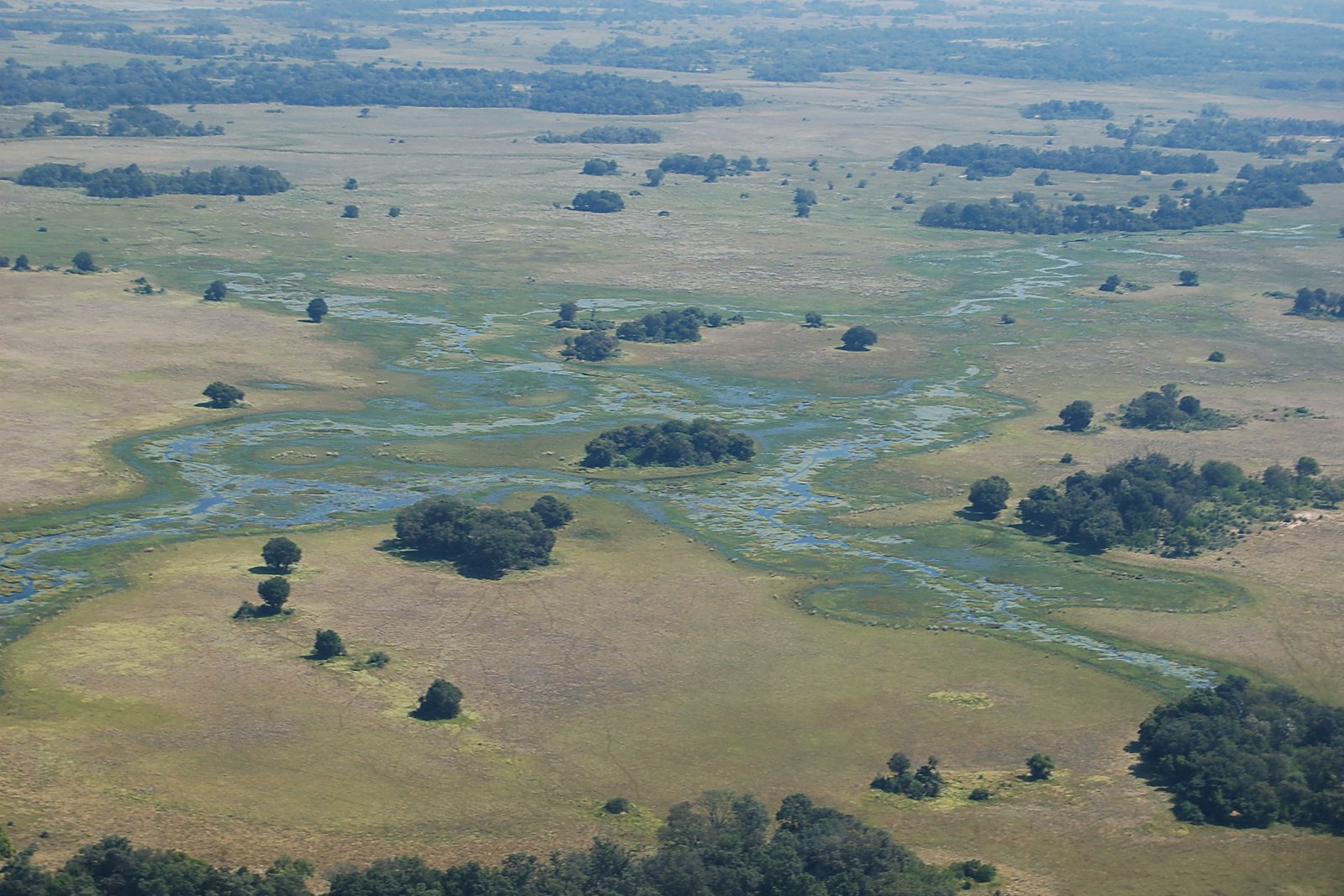
The Okavango cannot really be done without flying. Most of the Delta camps sit on islands or in private concessions with no road in at all, so the light aircraft is not a luxury but the only way through the door. The view from a Caravan at 500 feet — channels, lagoons, elephants wading below — is often what people talk about first when they get home. Our Botswana safari packages guide covers the camps; this routing is about getting you to them.
Indicative from-price with airfare: about US$6,800–8,200 per person from the US; about US$6,300–7,600 from Europe. Land itinerary: 8-Day Botswana & Zimbabwe Safari.


4. Masai Mara & Seychelles — 9 days
The flight chain: long-haul into Nairobi → night in Nairobi → Wilson Airport to a Mara airstrip by light aircraft → back to Wilson, transfer to Jomo Kenyatta → Nairobi to Mahé → long-haul home from the Seychelles.
Bush and beach trips are where open-jaw airfare matters: you fly into one country and home from another. Booked as two separate return tickets it costs more and wastes a day. Booked as one multi-city fare it flows from the savanna to the sea. The short hop from Nairobi to Mahé is under four hours, so you can watch a sunrise game drive and a sunset over the Indian Ocean within a couple of days of each other.
Indicative from-price with airfare: about US$10,300–12,000 per person from the US; about US$9,800–11,400 from Europe. Land itinerary: Masai Mara & Seychelles Safari-and-Beach. For a Tanzania version, the Tanzania & Zanzibar Bush-and-Beach runs the same idea with Kilimanjaro in and Zanzibar out.
5. Namibia Fly-In — 12 days
The flight chain: long-haul into Windhoek (direct from Frankfurt on some days, otherwise via Johannesburg) → light aircraft to Sossusvlei → to the Skeleton Coast or Damaraland → to Etosha → back to Windhoek → long-haul home.
Namibia is a big, empty country, and the distances between its highlights run to five or six hours on gravel. A fly-in circuit turns those days into 60- to 90-minute flights over dunes, dry riverbeds and the Atlantic coast. These circuits usually run on scheduled shared light aircraft, with private charters available for families or photographers. Because the light-aircraft legs are part of the land price, the airfare you add is mostly the long-haul.
Indicative from-price with airfare: about US$16,200–18,500 per person from the US; about US$15,700–17,800 from Europe. Land itinerary: Ultimate Namibia Fly-In Safari.
6. Sabi Sands Fly-In — 4 to 6 days
The flight chain: long-haul into Johannesburg → scheduled flight or lodge shuttle to a Sabi Sands airstrip (or Skukuza) → back to Johannesburg in time for an evening long-haul.
This is the shortest workable safari with airfare, and the one we suggest for people adding a few days of Big Five to a business trip or a Cape Town stay. Overnight flights from Europe land in Johannesburg in the morning; the hop to the reserve is about an hour, and you can be on an afternoon game drive the same day. The leopards of the Sabi Sands are the reason people come. Land itinerary: Luxury Sabi Sands Fly-In Safari; for a longer South African version, see the Ultimate South Africa Safari.
Indicative from-price with airfare: about US$8,000–9,500 per person from the US; about US$7,500–8,800 from Europe.
The six routings side by side
| Routing | Days | Flights after the long-haul | Light-aircraft bag limit | Indicative from-price with airfare* |
|---|---|---|---|---|
| Cape Town, Kruger, Vic Falls & Okavango | 14 | 4–5 | 20 kg | US$11,000–13,000 |
| Serengeti Great Migration | 7 | 2 | 15 kg (some routes 20 kg) | US$6,700–8,500 |
| Okavango, Chobe & Vic Falls | 8 | 3–4 | 20 kg | US$6,300–8,200 |
| Masai Mara & Seychelles | 9 | 3 | 15 kg | US$9,800–12,000 |
| Namibia Fly-In | 12 | 4–5 | 20 kg | US$15,700–18,500 |
| Sabi Sands Fly-In | 4–6 | 2 | 20 kg | US$7,500–9,500 |
*Indicative only: per person sharing, economy long-haul, shoulder season, from US East Coast or major European gateways. Final prices depend on dates, departure city, cabin class, camp choice and fare availability at the time of booking.
Want one of these priced for your dates? Send us your departure city and travel month and we will come back with real fares and a full itinerary, or browse the full range of safari packages first.
Light aircraft luggage: the rule that surprises everyone
If you remember one practical thing from this page, make it this. The small planes that fly you into camp have strict weight limits, because every kilo counts on a short dirt strip in the heat. The usual rules are:
| Region | Typical allowance per person | Bag type |
|---|---|---|
| Kenya (Masai Mara, Laikipia, Amboseli) | 15 kg including hand luggage | Soft bag, no wheels or rigid frame |
| Tanzania (Serengeti, Ruaha, Selous) | 15 kg on most routes, 20 kg on some | Soft bag, no wheels or rigid frame |
| Botswana (Okavango, Linyanti, Kalahari) | 20 kg including hand luggage and camera gear | Soft bag, roughly 25 × 30 × 62 cm |
| Namibia fly-in circuits | 20 kg including hand luggage | Soft bag |
| South Africa lodge shuttles | 20 kg plus a small hand bag on most shuttles | Soft bag preferred |
Allowances vary by operator and aircraft, so we confirm the exact figure for every leg in your documents. A few things that help: most international airlines give you more than this, so pack to the light-aircraft limit, not the long-haul one. Most camps offer laundry, often included, so you need fewer clothes than you think. If you are flying on to a beach or city afterwards, we can store a second bag in Johannesburg, Nairobi or Arusha. Photographers with heavy lenses can buy an extra seat on many shuttles, and we can arrange it in advance. Our full guide to luggage restrictions on bush flights covers packing in detail.
When to book and when fares open
Most airlines release seats around 330 to 360 days before departure. The camps open their calendars earlier still, often 18 months or more ahead for the busiest months. The two work together: there is no point holding a cheap flight into Maun if the camp you wanted is full, and no point holding the camp if the light-aircraft seats have gone.
| Travel window | Why it is busy or quiet | When to book flights and camps |
|---|---|---|
| July – October | Peak dry season across East and southern Africa; Mara River crossings | 9–12 months ahead; earlier for the best Mara and Delta camps |
| Mid-December – early January | Holiday travel; long-haul fares at their highest | 10–12 months ahead |
| January – March | Serengeti calving; green season in southern Africa | 6–9 months ahead |
| April – June | Long rains in East Africa; Delta flood arriving in Botswana from about June | 4–8 months ahead; good fare value |
| November | Short rains in East Africa; hot, quiet and good value in the south | 4–6 months ahead |
Two practical points. First, midweek departures are often cheaper on long-haul routes than Friday and Saturday. Second, if you have airline miles or points, use them on the long-haul — that is where they go furthest — and let us book the regional and light-aircraft legs around them. We do this regularly; the package simply covers everything except the long-haul fare.
What is included, and what is not
"All-inclusive safari with airfare" means different things to different companies. Here is what our airfare-inclusive packages usually cover, and what they leave out. If a quote you are comparing does not spell this out, ask.
| Usually included | Usually not included |
|---|---|
| Return international flights in your chosen cabin | Visas and entry fees (some are payable online before travel) |
| All regional flights and light-aircraft legs, with taxes | Travel insurance (strongly advised) |
| All airport and road transfers | Gratuities for guides, trackers and camp staff |
| Accommodation as listed, usually full board at camps | Premium drinks and imported spirits at some camps |
| Twice-daily game activities with a guide | Optional extras such as balloon flights or helicopter flips |
| Park and conservation fees | Extra baggage or extra seats on light aircraft |
| Local drinks and laundry at most safari camps | Meals in cities where marked as own arrangements |
For the bigger picture on what a safari costs before flights, the African safari cost and budget guide breaks the land side down by country and season. If you want every drink and activity on the bill too, see our guide to all-inclusive luxury safari packages.



Insurance and visas
Travel insurance is not optional on a trip with this many flights. You want cover for cancellation, missed connections, lost or delayed baggage and medical evacuation; at remote camps, evacuation is usually by air, and it is expensive without a policy. Check that your policy covers light aircraft and the activities you plan, such as walking safaris or balloon flights. Our guide to safari travel insurance sets out what to look for.
Visa rules differ by passport and country, and they change. As a general picture: Kenya uses an electronic travel authorisation, Tanzania and Rwanda offer e-visas, Zambia and Zimbabwe share the KAZA UniVisa for travellers visiting both, and South Africa, Botswana and Namibia admit many Western passport holders visa-free for short visits. Always check the official rules for your passport before travel; our visa requirements guide keeps the common cases in one place. South Africa also expects at least two blank passport pages, and some countries ask for six months' validity beyond your stay.
Why one booker matters when a flight runs late
This is the part nobody puts in the brochure. Long-haul flights into Africa are generally reliable, but delays happen — weather in a European hub, a technical issue in Doha, a slot problem at Johannesburg. When your flights are all on one booking with one company, a delay is our problem to solve, not yours.
Here is what that looks like in practice. Your flight into Johannesburg lands three hours late and you miss the connection to Maun. On separate tickets, you are queuing at a transfer desk, the regional airline owes you nothing because it never knew you were connecting, and the light aircraft into camp has already left, because bush planes do not fly after dark. With one booker, someone has already seen the delay on the flight tracker before you landed, moved you to the next flight, booked a hotel near the airport if needed, told the camp, and rebooked the light aircraft for the morning. You lose an afternoon, not a day and a lot of money.
We build buffers in from the start, too. We avoid tight connections between long-haul and regional flights, and where the light aircraft is involved we usually allow a night at the gateway rather than gambling on a same-day transfer. It adds a night to the trip, and it saves trips. That is the whole reason to book a safari package with airfare rather than a safari with your own flights bolted on.
How we put your package together
It starts with three questions: where you are flying from, roughly when, and what you most want to see. From there we look at the camps first, because they set the dates. Then we hold the light-aircraft seats that go with them, then the regional connections, and finally the long-haul fare that fits around everything else. You get one itinerary with every flight number, every transfer time and every baggage limit written in, plus a contact on WhatsApp for the whole trip.
If you would like to start, tell us your plans here, or message us directly on WhatsApp. We will come back with routings and real fares for your dates. If you are planning a honeymoon, the honeymoon packages guide shows how we build those trips around the flights too.
Your long-haul gets you to Africa. Everything after that is what we do.